
Jump to
1. Introduction
Food security remains a critical global issue, shaped by rising populations, climate uncertainty, biodiversity loss, and widening socio-economic inequalities (Aborisade and Bach, 2014; Godfray et al., 2010; Lindgren et al., 2018). Ensuring access to affordable, nutritious, and sustainable diets requires a systems-based perspective that considers economic, nutritional, and environmental dimensions together (Abu and Oldewage-Theron, 2019). Microsimulation models are increasingly recognized for their ability to navigate this complexity. These models simulate household and individual responses to interventions, such as taxes, subsidies, dietary shifts, and climate impacts producing detailed insights into distributional impacts and policy trade-offs (Boulanger et al., 2022; Breisinger and Ecker, 2014; Clapp et al., 2022; Diao et al., 2022). This paper reviews microsimulation approaches used in the food security-nutrition-environmental nexus.
Traditional food security models have relied heavily on macro-level frameworks and static indicators, offering high-level insights into dietary patterns and environmental footprints but often failing to account for household-level heterogeneity and dynamic feedbacks (Behrens et al., 2017; Green et al., 2015; Heller et al., 2018). These aggregate approaches obscure how interventions affect diverse socio-economic groups, limiting their value for designing equitable, context-specific policies (Béné, 2020; Leeuwis et al., 2021). Microsimulation modelling offers a breakthrough by simulating individual and household responses to policy interventions, such as taxes, subsidies, dietary shifts, and climate shocks, while accounting for demographic diversity, behavioural variability, and spatial differentiation (Boulanger et al., 2022; Diao et al., 2022; O’Donoghue, 2014). Unlike aggregate models, it enables granular analysis of distributional impacts and policy trade-offs within interconnected food systems.
Despite their growing use in food policy research, most microsimulation models remain fragmented, addressing nutrition, affordability, or environmental sustainability in isolation. Many studies simulate the health and economic impacts of interventions such as sugar-sweetened beverage taxes, nutrient reformulation, or food labeling, showing improvements in diet quality and reductions in chronic disease risk (Lee et al., 2020; Pearson-Stuttard et al., 2018; Shangguan et al., 2021). Others assess food assistance programs like SNAP or produce prescriptions, demonstrating gains in nutritional adequacy and reduced disparities for low-income households (Choi et al., 2021; Mozaffarian et al., 2018; Wang et al., 2023). However, these models often pursue a single policy objective such as improving health or reducing costs without linking outcomes to environmental or equity dimensions.
More recent efforts have extended microsimulation to broader domains, including fiscal and agricultural policy. Simulations of VAT reforms, fertilizer subsidies, and market interventions have examined their effects on poverty, prices, and household welfare (Boulanger et al., 2022; O’Donoghue, 2014; Ramos et al., 2022), while others have explored food system shocks such as COVID-19 and the Ukraine war (Ayaz et al., 2022; Headey et al., 2020; Nechifor et al., 2021). A smaller body of work models carbon and sin taxes on food, highlighting their potential for emissions reduction and dietary improvements (Caillavet et al., 2019; Kehlbacher et al., 2016; Klenert et al., 2023). Yet, even the most advanced models typically evaluate outcomes in parallel rather than as interconnected elements. Building on this, recent reviews have explored how different modelling approaches address these interconnected challenges, offering insights into current strengths and limitations.
Recent reviews underline the growing consensus that microsimulation modelling is essential for advancing food security research amid its inherent complexity and multidimensionality. Mertens et al. (2022) position microsimulation as a methodological breakthrough, offering the ability to capture individual-level heterogeneity and dynamic feedback within food systems. Building on this, Dave et al. (2023) argue that incorporating nutrient bioavailability and food biodiversity into microsimulation models would further enhance their realism, enabling more accurate simulation of real-world dietary choices and constraints. Mui et al. (2025) also point to the utility of microsimulation within broader systems science simulation modelling (SSSM) frameworks, especially for analysing equity in the retail food environment. However, they critique current models for often overlooking social and political contexts and failing to meaningfully engage stakeholders. Complementary reviews stress that fragmented or oversimplified indicators (Jones et al., 2013; Manikas et al., 2023) and the proliferation of disparate metrics (Teeuwen et al., 2022) obscure crucial systemic trade-offs and dimensions such as nutrition, equity, and environmental sustainability. Li et al. (2023) and McKay et al. (2019) further call for holistic, multidimensional approaches that integrate both objective and subjective measures. Collectively, this literature highlights the urgent need for microsimulation-driven frameworks capable of unifying diverse dimensions of food security, capturing distributional and equity impacts, and ultimately guiding more effective and nuanced policy design.
This review is intentionally broad, reflecting the diversity of microsimulation modelling approaches in food policy, and aims to guide the design of microsimulation models across complex and interdisciplinary domains. It specifically asks:
How have microsimulation models been used to assess food security outcomes at household and individual levels?
To what extent do these models incorporate multidimensional drivers, including nutritional adequacy, economic affordability, and environmental impacts?
What methodological innovations and limitations emerge from the literature, and what are the priorities for advancing microsimulation in food security research?
By mapping existing applications and identifying critical gaps, the review offers a roadmap for using microsimulation to support equitable, adaptive, and integrated food policy design.
The paper is structured to comprehensively address the topic. Section 2, Theoretical Framework, introduces fundamental concepts and microsimulation models. Section 3, Methodology, outlines the hybrid review process. Section 4, Results, presents key findings on food security dimensions and the use of microsimulation models. Section 5, Discussion, highlights key takeaways, research gaps, and future research implications. Finally, Section 6, Conclusion, summarizes the analysis and overall conclusions.
2. Theoretical framework
In this section we develop, a theoretical framework for analysing complex aspects like affordability, nutrition, and environmental sustainability aspects of food security research (Simelane and Worth, 2020). Ravitch and Riggan (2016) emphasize the framework’s role in explaining and forecasting the interrelations among different concepts and variables. It helps classify numerous concepts found in the literature, showing their interconnectedness in achieving household food and nutrition security (Kivunja, 2018).
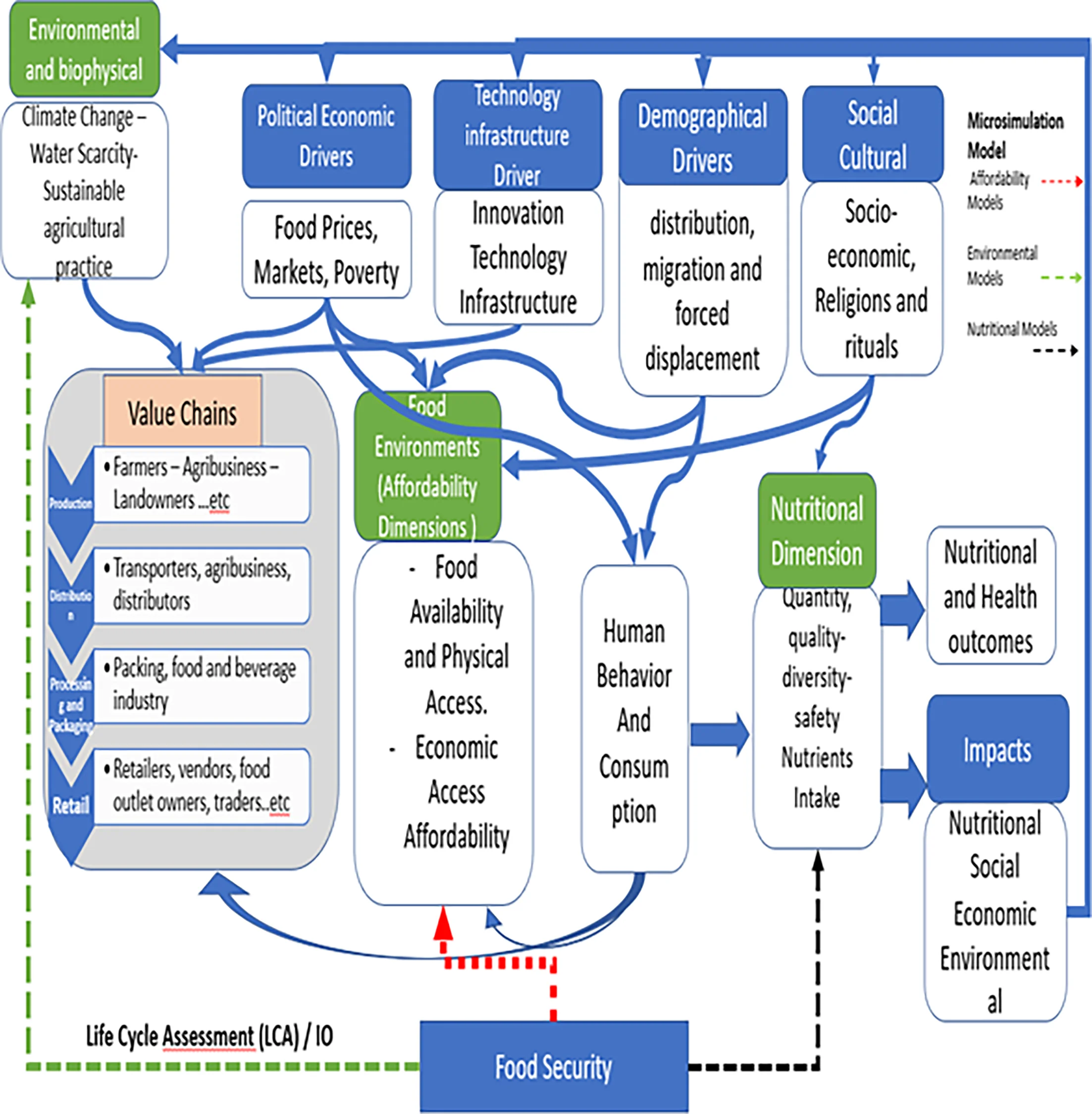
Given the complexities of food security, we have developed a theoretical framework for our review. This framework explores how factors like food access, affordability, environment, nutrition, human behaviour, and health are interconnected. Our aim is to offer practical suggestions for building affordable, healthy, and sustainable food systems worldwide, ultimately improving global food security and well-being.
Figure 1 presents an overview of the theoretical framework for examining food security using value chain and microsimulation modelling, inspired by Pingault et al. (2017). This framework provides a foundation for understanding the holistic processes within food security. While Sam et al. (2019) highlighted the interplay between household adaptive capacity, drought risk, and food security, and Ogundari (2017) expanded on socio-economic and demographic factors influencing rural food security, these frameworks lack the depth provided by microsimulation or CGE-micro models. Our review addresses this gap by using microsimulation modelling to dissect the complex interplay within food security dimensions, informing targeted policy development.
2.1. Insights from microsimulation models
Microsimulation models are computer-based tools used to model real-world systems and populations at the unit level, such as individuals, households, or businesses (O’Donoghue, 2014). While they are applied across various sectors like firms (Buslei et al., 2014; Eliasson, 1991) and farms (Odonoghue et al., 2016), their primary use is in individual or household (Sutherland and Figari, 2013), making them vital for policy and decision-making.
Microsimulation models stand out from other approaches by offering detailed, individual-level analyses that capture population diversity, enabling nuanced examinations of policy impacts on different demographic groups (Brown, 2011). Unlike broader economic models like Computable General Equilibrium (CGE) models, which aggregate the economy’s response to policy changes (Debowicz, 2016; Zhang, 2017), or Bio-Economic Models, which merge biological and economic aspects (Antle and Capalbo, 2017), microsimulation models focus on the specific responses of individuals and households. This detailed approach makes them particularly suited for analysing the distributional effects of policies in areas such as taxation, social welfare, and health interventions. The granularity of these models empowers policymakers to design interventions tailored to the diverse needs and circumstances of different population segments, enhancing policy effectiveness and equity.
2.2. Value chains and food security dimensions
In our review, we adopt a theoretical framework that combines value chain analysis with microsimulation modelling, shedding light on the journey of food from production to plate, as conceptualized by Cucagna and Goldsmith (2018). This framework intricately maps out the path of food through its lifecycle, emphasizing the influence of environmental factors on availability and access.
We incorporate Computable General Equilibrium (CGE) models to provide a macro-level view of economic impacts, integrating them with microsimulation models to connect broad policies with individual effects. This dual approach offers a comprehensive perspective on food security, linking macroeconomic policies with micro-level implications across the supply and value chains, ensuring a deep understanding of the interplay between economic forces and individual outcomes.
2.3. Human behaviour
At the core of our analysis is the human behaviour dimension, which is closely linked to consumption and influences food security (Deaton, 2005). This dimension shapes what, how, and why people eat, directly impacting household food security and sustainability factors like climate change and water scarcity (Timmer, 2012). Microsimulation models are important for explaining the interplay between individual and household characteristics, consumption patterns, and environmental implications (Ballas et al., 2013).
Behavioural economics provides insights into food security by examining how psychological factors influence food-related decisions (Timmer, 2010). Concepts such as loss aversion, time inconsistency, and herd behaviour significantly affect responses to food price changes and availability. For instance, loss aversion can cause households to overreact to price increases, leading to behaviours like panic buying and hoarding, which exacerbate market volatility and food insecurity (Kahneman and Tversky, 1979).
Historical events, such as the 2007-2008 rice price crisis, illustrate these behavioural impacts. During the crisis, speculative bubbles and hoarding driven by fear of shortages led to sharp price spikes, highlighting the need for policy interventions that address such behaviours (Timmer, 2010). Additionally, studies by Barrett and Lentz (2015) emphasize the role of trust in food systems, showing that lack of trust can lead to increased food insecurity due to reduced market participation and reliance on informal food sources.
Moreover, psychological and cultural factors, as explored by Minten and Barrett (2008), demonstrate how cultural preferences and social norms can influence dietary choices and nutritional outcomes. For example, in some cultures, there is a strong preference for staple grains over more nutritious but less culturally significant foods, which can impact nutritional security Briones Alonso et al. (2018). Further, the work of Braun et al. (1999) on the impact of food aid and subsidies highlights how different forms of aid can alter consumer behaviour, sometimes leading to unintended negative consequences such as dependency or market distortions. Understanding these nuances is vital for designing policies that promote sustainable food security.
In the following paragraphs, we will delve deeper into how human behaviour influences the nutritional, affordability, and environmental aspects of food security, highlighting the critical role of microsimulation models in interpreting these connections. By incorporating detailed behavioural data, these models can predict how policy changes, economic conditions, and environmental factors might alter consumption patterns and food security outcomes.
2.4. Nutrition dimension
The nutritional dimension is vital in food impact analysis, with microsimulation models playing a key role in unravelling its complexity within food security. These models play an important role in examining nutritional aspects of food security, offering nuanced perspectives on how policy shifts and economic dynamics influence dietary behaviours and nutrient intake at an individual level (Abdul Hakim, 2018). By simulating real-life scenarios, such as the impact of food subsidies or taxes, these models provide actionable insights for enhancing nutritional health, particularly among vulnerable groups. Their ability to pinpoint micronutrient deficiencies and inform targeted interventions underscores their value in crafting strategies for comprehensive nutritional security, making them essential for informed policymaking in the realm of food security (Darmon and Drewnowski, 2015).
This dimension is central to our analysis, where we explore dietary adequacy, intake, and diversity, emphasizing the critical role of nutrition in determining health outcomes. By analysing consumption patterns, we uncover how choices around the types and quantities of food consumed directly influence the nutritional status of individuals and communities. Nutrition is not only about meeting energy needs but also ensuring access to a diverse range of nutrients essential for good health, underscoring the importance of a balanced diet in securing food security.
However, nutrient adequacy alone does not guarantee improved health outcomes. Factors such as nutrient bioavailability (Hurrell and Egli, 2010), food preparation methods (Gibson et al., 2006), cultural dietary norms, and broader social determinants of health including sanitation, education, and gender dynamics (Hawkes et al., 2020) significantly affect how nutrients are absorbed, distributed, and utilized. For instance, non-heme iron absorption varies widely based on the presence of enhancers like vitamin C or inhibitors such as phytates and polyphenols (Hurrell and Egli, 2010). Cultural taboos or intra-household food allocation may further restrict access to nutrient-rich foods despite apparent adequacy in diets. These dimensions are increasingly recognized as important for accurately modelling and interpreting the real-world impact of dietary interventions, particularly in contexts of vulnerability and inequality.
2.5. Environment dimension
The environmental dimension of food security can be interconnected with microsimulation modelling, enabling a comprehensive analysis of sustainable practices within the food value chain. For instance microsimulation models assess practices like crop rotation and their wider environmental impacts, such as carbon footprint reduction, and analyse food waste policies for food security enhancement (Jones et al., 2013; Quested et al., 2013). By incorporating detailed environmental data and sustainability metrics, microsimulation models can provide insights into the complex relationship between food security and environmental sustainability. They can allow policymakers to visualize the potential consequences of specific environmental interventions on food systems and identify strategies that harmonize food security objectives with environmental goals.
2.6. Affordability dimension
In our framework, the examination of the affordability dimension utilizes economic variables such as food prices and household incomes to assess their impact on access to nutritious food, highlighting the interplay between the cost of food and household purchasing power (Powell et al., 2013). Data on these variables allow us to consider how affordability influences food security. This exploration is further deepened by the integration of insights from Computable General Equilibrium (CGE) models, which provide a macroeconomic perspective on the repercussions of economic policies within the food sector. Combined with the individual-level impacts, the offer a comprehensive view of affordability’s role in food security (Cockburn et al., 2010). This multifaceted approach facilitates a nuanced understanding of the economic underpinnings of food security, guiding the development of targeted interventions aimed at improving access to nutritious food for all population segments.
2.7. Policy instruments
Figure 2 in our review showcases the role of microsimulation models in analysing the impacts of diverse policies on key food security aspects like affordability, nutrition, and environmental sustainability. By leveraging models such as EUROMOD (Immervoll and O’Donoghue, 2009), we explore the efficacy of social welfare initiatives in improving household food affordability, which in turn enhances overall food security (Penne and Goedemé 2021). Similarly, models like CVD PREDICT highlight the significance of dietary interventions in mitigating nutrition-related health risks (Liu et al., 2020). Additionally, household microsimulation approaches provide a broader perspective on the interplay between agricultural policies, economic factors, and nutritional programs, offering comprehensive insights into their collective influence on food security (Viera, 2023).
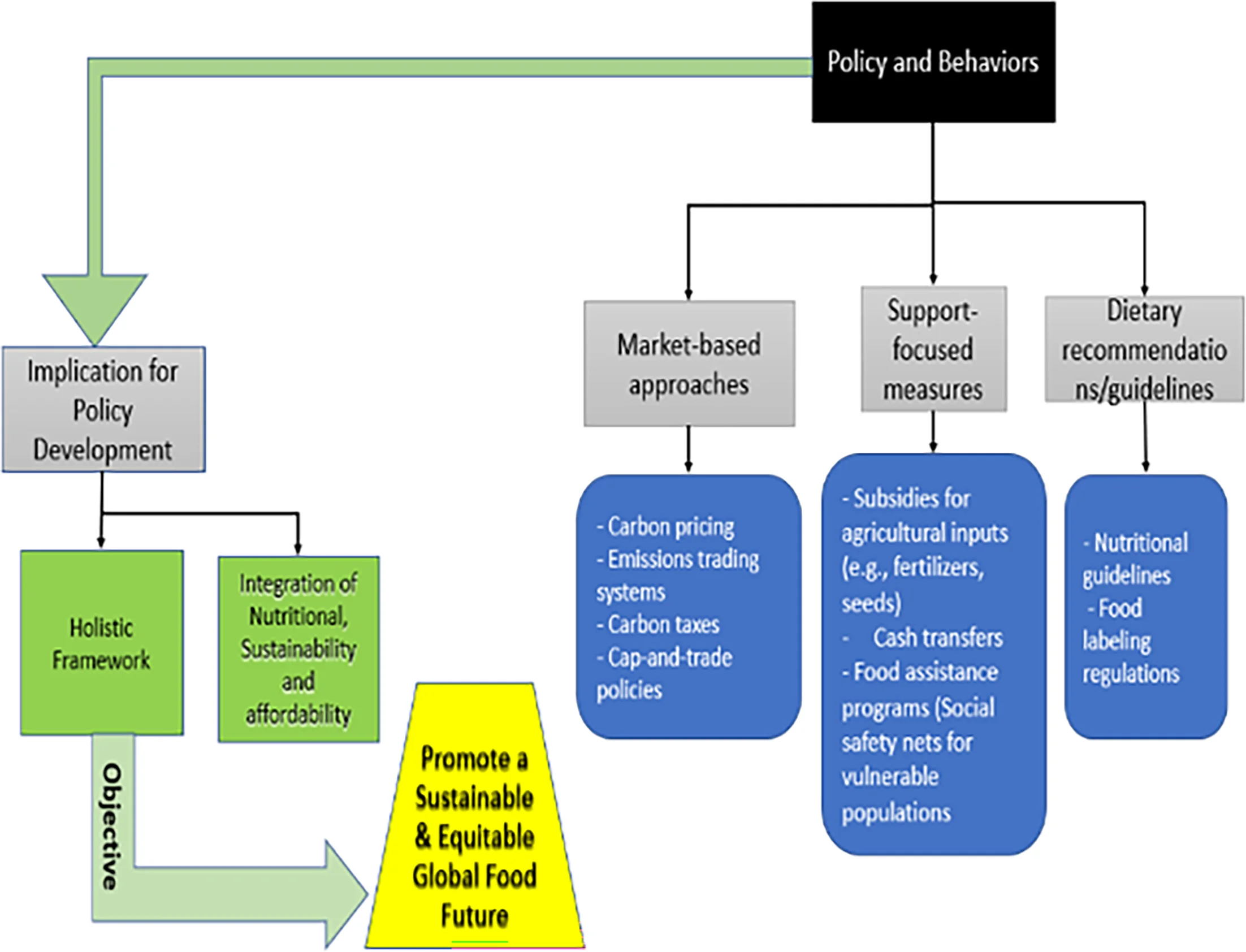
The diagram further expands our understanding by delineating various policy approaches, including market-based mechanisms, support-focused measures, and dietary guidelines, each contributing uniquely to food security. From carbon pricing strategies and agricultural subsidies to nutritional guidelines and food assistance programs, these interventions illustrate the spectrum of policy tools available to tackle food security challenges. This layered analysis, underpinned by the detailed insights from microsimulation models and the holistic view presented in Figure 2, underscores the complexity of formulating policies that effectively address the multifaceted nature of food security. Through this integrative approach, our review aims to guide the formulation of informed, sustainable, and equitable policies that pave the way for a global food-secure future.
3. Methodology
The review’s methodology focuses on the interplay between food security aspects affordability, nutrition, and environmental sustainability using microsimulation models to inform sustainable food policies. Different literature review approaches, ranging from qualitative textual analysis to quantitative bibliometric analysis, have their own benefits and drawbacks (Snyder, 2019). Bibliometric studies offer broad overviews but lack depth in understanding model details (Ellegaard and Wallin, 2015), while traditional reviews provide detailed insights but struggle with extensive literature coverage (Boell and Cecez-Kecmanovic, 2014). SLRs, which utilize content analysis, offer a thorough and detailed examination of the subject matter but can be time-consuming and limited in the number of papers reviewed (Bartolucci and Hillegass, 2010; Petticrew and Roberts, 2008). Given the complexity and interdisciplinary nature of microsimulation in food policy, a hybrid approach was adopted one that combines the breadth of bibliometric mapping with the analytical depth of SLRs (Turnbull et al., 2023).
Although this paper is not a systematic review in the strict sense, we adopted elements of the PRISMA framework (Page et al., 2021) to ensure a transparent, structured, and replicable review process. PRISMA’s guidelines provided a strong foundation for documenting search strategies, screening procedures, and inclusion criteria, thereby enhancing methodological clarity (Moher et al., 2015). However, due to the interdisciplinary and evolving nature of microsimulation modelling in the food system domain, we applied a hybrid approach that balances structure with flexibility. To expand coverage beyond standard database searches, we integrated a citation-based snowballing strategy (Greenhalgh and Peacock, 2005), allowing us to identify additional influential studies and policy-relevant work not captured through initial keyword searches. This combined method enabled a comprehensive yet focused review of the literature.
The review began by defining a clear research question, followed by creating a theoretical framework to structure the study on microsimulation models for food security. Google Scholar was used for its broad coverage of both academic and grey literature, including reports and conference papers, to capture the full spectrum of existing knowledge and innovations in the field (Adams et al., 2016). This strategy provided a comprehensive view of the field, incorporating insights from diverse sources.
3.1. Search Strategy
The literature search targeted peer-reviewed articles and grey literature published between 2013 and 2023, a period marked by significant advancements in microsimulation techniques and heightened focus on food security driven by the Sustainable Development Goals (SDGs), climate action, and improvements in data and computational methods.
Searches were conducted using Google Scholar for its broad coverage of academic and grey literature, complemented by manual screening of references from key articles to identify additional studies (Adams et al., 2016). The search string combined relevant terms to capture the intersection of microsimulation and food security:
("Food security" OR "Food insecurity" OR “Food Consumption”) AND (“Household” OR “Individuals”) AND ("Microsimulation models" OR “Microsimulations” OR “Microsimulation” OR "Micro-simulation") AND ("Affordability" OR "Economic access" OR "Income" OR "Environment" OR "Sustainability" OR "Climate change" OR "Nutrition" OR "Dietary patterns" OR "Diet" OR "Health")
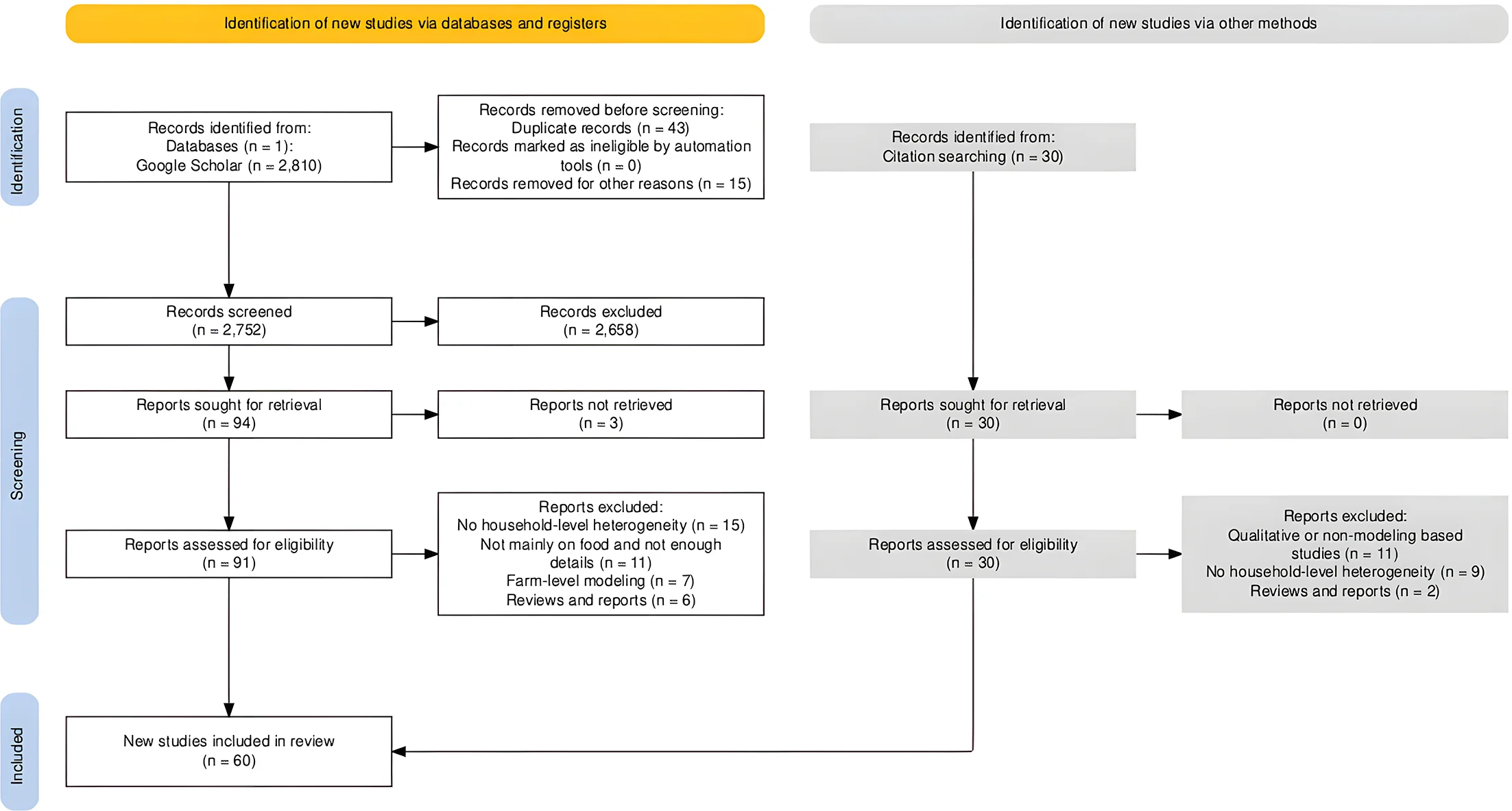
This search retrieved 2,810 records from Google Scholar and an additional 30 studies through citation tracking, resulting in a total of 2,840 records. Following the removal of 58 duplicates (43 duplicates and 15 irrelevant records), 2,752 records proceeded to screening. Titles and abstracts were screened to exclude studies that clearly did not meet the eligibility criteria, resulting in the exclusion of 2,658 records. Of the remaining 94 studies, three could not be retrieved in full, leaving 91 articles for detailed eligibility assessment. An additional 30 articles identified through citation searches were also assessed.
Eligibility screening applied the following inclusion criteria: studies published in English between 2013 and 2023 that employed microsimulation modelling (including standalone and CGE-linked approaches) to assess food security dimensions, namely affordability, nutrition, and environmental sustainability at the individual or household level. Studies were excluded if they were reviews or reports, lacked household-level heterogeneity, focused solely on farm-level modelling, or were qualitative or non-modelling based.
After full-text assessment, 38 studies from the database search were excluded for reasons such as lacking household-level heterogeneity (n=15), insufficient focus on food systems or insufficient methodological detail (n=10), farm-level modelling only (n=7), or being review articles (n=6). From the citation search, 22 studies were excluded due to qualitative approaches (n=11), lack of household-level heterogeneity (n=9), or being reviews (n=2). Ultimately, 60 studies were included in the final synthesis, as illustrated in Figure 3 (PRISMA flow diagram).
Data from these studies were extracted, focusing on the type of microsimulation model, the scope of food security dimensions addressed, geographic and population coverage, and the policy interventions simulated (taxes, subsidies, dietary shifts, etc.). The synthesis combined quantitative mapping of study characteristics with qualitative analysis to identify methodological advances, limitations, and future opportunities for leveraging microsimulation in food security research.
4. Results
Our results distil key patterns in the food security literature, covering environmental, nutritional, health, and economic dimensions. We examine carbon modelling and emissions across the food system, along with how nutrient types and volumes are assessed. The review also highlights health–nutrition links, behavioural responses, and policy impacts. Definitions of food insecurity and intra-household dynamics are discussed, as well as the integration of microsimulation with macroeconomic models. Together, these findings offer a clear picture of how food security is currently modelled.
4.1. Application
Understanding the analytical focus of microsimulation studies is critical for informing policy design that balances environmental sustainability, nutritional adequacy, and affordability. Table 1 shows that all 60 reviewed studies applied microsimulation modelling (100%) and addressed at least one core dimension environment, affordability, or nutrition. Affordability was the most frequently examined dimension (95%), followed by nutrition (68%), and environment (20%). Only 46% of studies considered both affordability and nutrition jointly, while just 8% assessed both environment and nutrition. A mere 16% of papers integrated all three dimensions, highlighting a persistent gap in multidimensional policy evaluation. Existing literature underscores that environmental concerns remain underrepresented in affordability-focused models (Drew et al., 2020), and most current frameworks lack the integration necessary for assessing cross-dimensional trade-offs. These findings point to the urgent need for more holistic modelling approaches that can support the design of coherent, cross-sectoral food policies.
| Analytical Focus | Number of Papers | Probability |
|---|---|---|
| Microsimulation Models | 60 | 100% |
| At Least One Dimension | 60 | 100% |
| Environment | 12 | 20% |
| Affordability | 57 | 95% |
| Nutrition | 41 | 68% |
| Environment affordability | 3 | 5% |
| Environment Nutrition | 5 | 8% |
| Affordability Nutrition | 27 | 45% |
| All Dimensions Discussed | 10 | 16% |
Food security is a global issue, requiring comprehensive research across different regions. Figure 4 shows that Africa was the most researched region with 26 studies. Asia followed with 9 studies, covering nations like Bangladesh, Pakistan, and Myanmar. Europe and North America had 7 and 14 studies respectively, often focusing on policy impacts and health outcomes associated with dietary patterns. Additionally, 1 study was in Australia/Oceania, one in South America and two multiple where developing countries included (Asia/Africa).
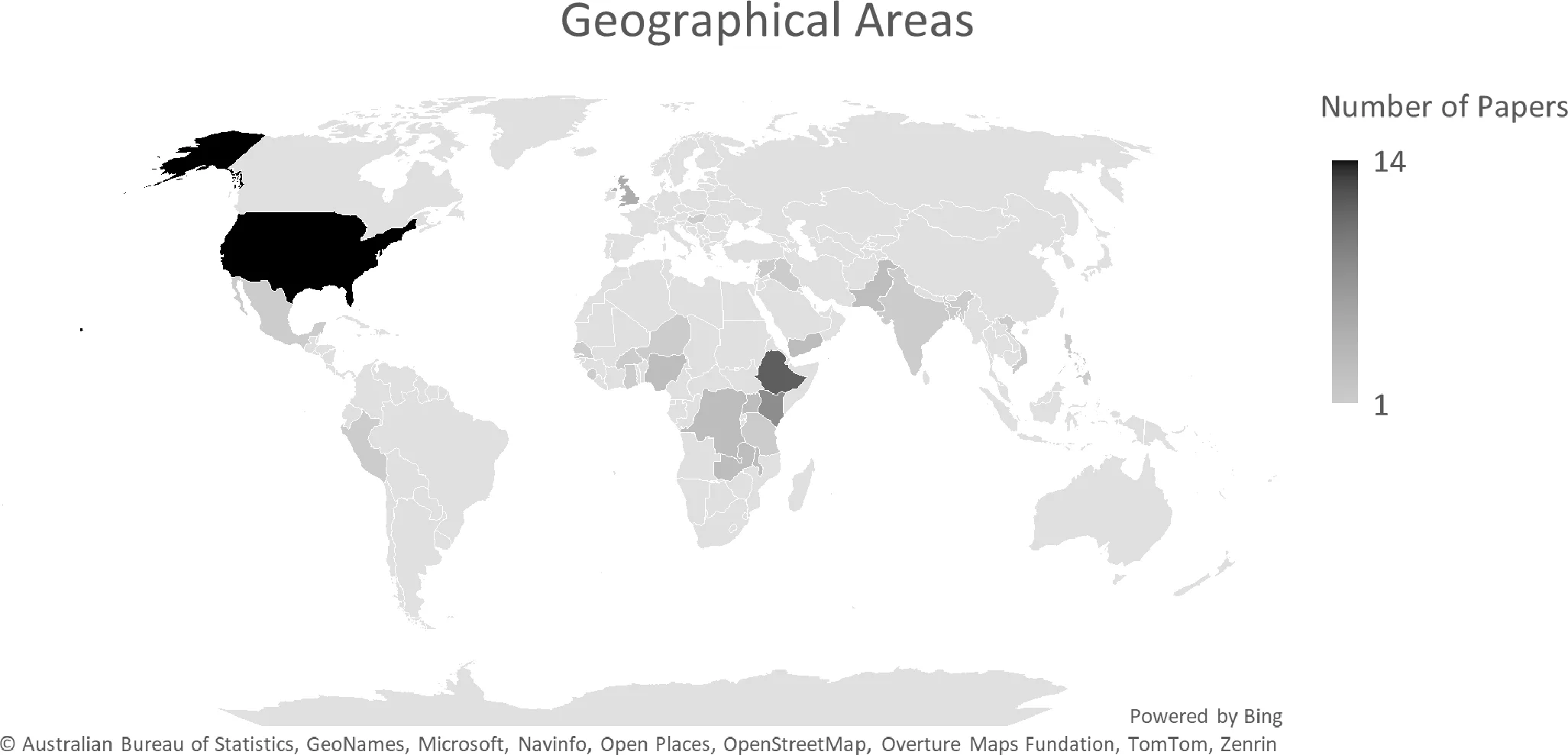
Table 2 shows the distribution of applications across geographical regions, highlighting distinct focus areas between developed and developing contexts. In Africa, the majority of applications focused on agricultural development (Aragie et al., 2023), social protection and food security (6), and economic policies (5), reflecting priorities to strengthen rural systems and poverty alleviation. Asia similarly emphasized social protection (4) and climate change and food production (2). In contrast, North America focused primarily on food assistance programs (5) and health and diet quality (6), targeting nutrition and vulnerable populations. Europe’s studies focused on environmental sustainability (2) and taxation and health economics (3), while Australia/Oceania had only one study, which addressed health and diet quality. South America also showed minimal representation, with one study on social protection and food security. These patterns indicate that developing regions prioritize foundational issues such as agricultural policy and food security, while developed regions focus more on targeted themes like nutrition, health, and sustainability.
| Application Category | Africa | Asia | North America | Europe | Australia/Oceania | South America | Cross Continent (Asia/ Africa) |
|---|---|---|---|---|---|---|---|
| Food Assistance Programs/Food Stamps | 0 | 1 | 5 | 0 | 0 | 0 | 0 |
| Environmental Sustainability | 1 | 0 | 1 | 2 | 0 | 0 | 0 |
| Social Protection and Food Security | 6 | 4 | 1 | 1 | 0 | 1 | 1 |
| Economic Policies and Fiscal Studies | 5 | 2 | 0 | 1 | 0 | 0 | 0 |
| Agricultural Development and Policies | 10 | 0 | 0 | 0 | 0 | 0 | 0 |
| Health Impact and Diet Quality | 1 | 0 | 6 | 0 | 1 | 0 | 1 |
| Climate Change and Food Production | 2 | 2 | 0 | 0 | 0 | 0 | 0 |
| Taxation and Health Economics | 1 | 0 | 1 | 3 | 0 | 0 | 0 |
| Total | 26 | 9 | 14 | 7 | 1 | 1 | 2 |
4.2. Characteristics of included studies
Microsimulation modelling in food security has gained significant traction over the past decade, reflecting its growing relevance in addressing complex, multidimensional policy challenges. Figure 5 illustrates this trajectory across three dimensions: unit of analysis, publication trends, and types of populations studied. This analysis not only maps the evolution of the field but also highlights methodological patterns and gaps that have implications for the design and interpretation of food security policies.
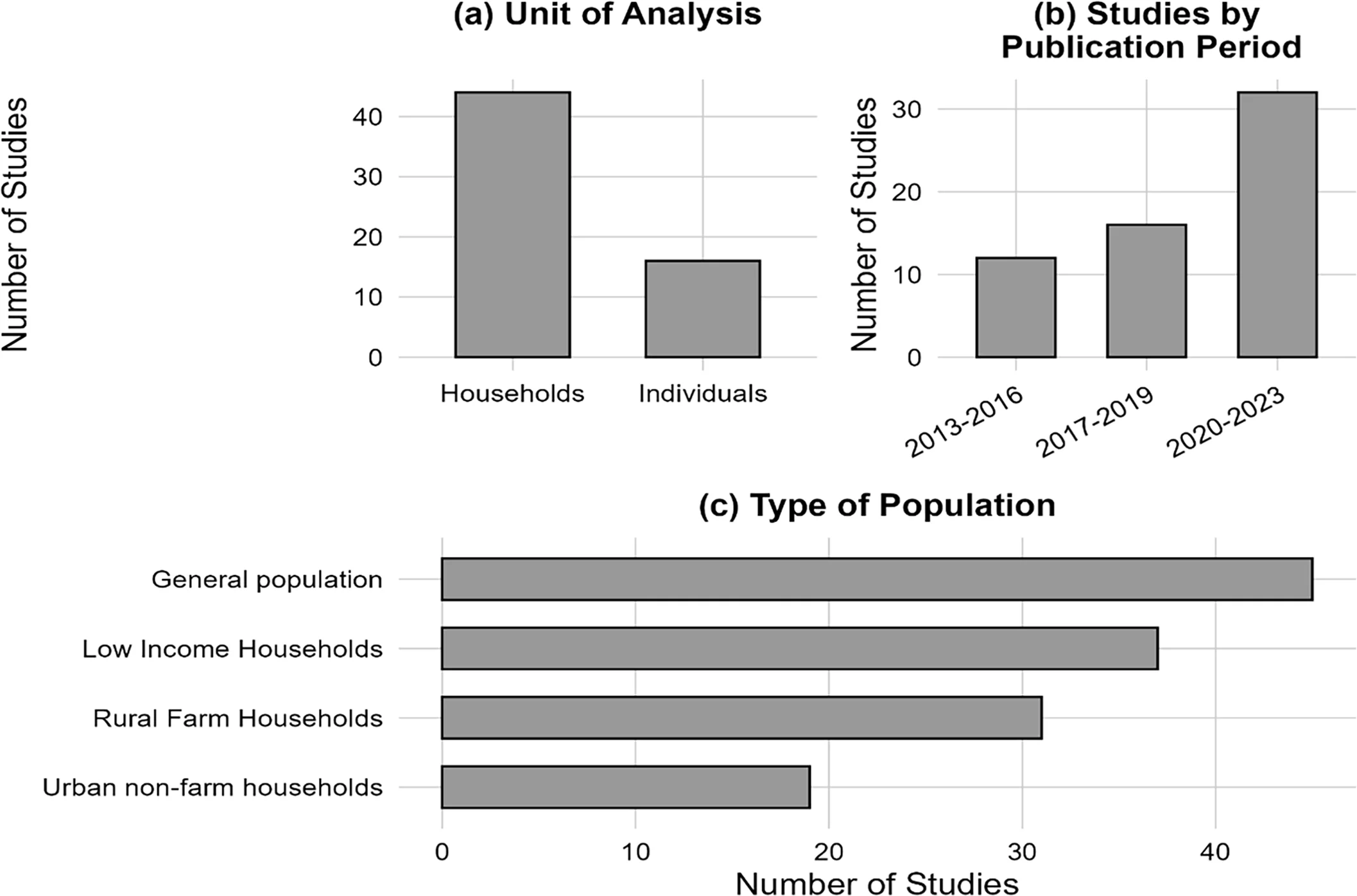
Panel (a) defines the unit of analysis as the level at which data is modelled either households or individuals. Among the reviewed studies, 73% (n=43) employed households as their unit of analysis, while only 27% (n=17) focused on individuals. This dominance of household-level analysis likely reflects the widespread availability and practicality of household surveys in capturing consumption and expenditure data. However, it also reveals a gap in modelling intra-household dynamics and individual-level nutritional adequacy, which are critical for understanding disparities in food access and dietary outcomes (Naska et al., 2001).
Panel (b) shows the distribution of studies over time, revealing a marked increase in publications in recent years. Between 2013 and 2016, 12 studies were published, increasing slightly to 16 from 2017–2019. Notably, there was a dramatic surge to 32 studies between 2020–2023. This acceleration coincides with global crises such as the COVID-19 pandemic, which exposed vulnerabilities in food systems and spurred interest in using microsimulation to model shocks and policy responses (Ecker et al., 2023; Nechifor et al., 2021). The trend underscores the field’s growing responsiveness to real-world disruptions and its potential for informing adaptive policymaking under uncertainty.
Panel (c) categorizes the populations modelled in these studies. The majority target the general population (n=45), followed by low-income households (n=38), rural farm households (n=32), and urban non-farm households (n=18). While the focus on vulnerable groups such as rural and low-income populations is commendable, the relative underrepresentation of urban households is noteworthy given rapid urbanization and its implications for food security dynamics (Cohen and Garrett, 2010). This suggests a need for more urban-focused microsimulation research to capture the specific challenges of food access in densely populated settings.
4.3. Type of survey
Understanding population nutrition requires integrating data from both Household Budget Surveys (HBS) and Individual Dietary Surveys (IDS), as these approaches offer complementary insights (Naska et al., 2001). HBS collects household-level data on food purchases and expenditures over a defined period, typically seven days, enabling analysis of food spending, income, and consumption patterns (Trichopoulou et al., 2002; Zintzaras et al., 1997). In contrast, IDS uses methods such as food diaries or 24-hour recall interviews to capture individual-level dietary intake across all ages and genders, often over several months to a year, providing detailed information on nutrient intakes and dietary patterns (de Oliveira et al., 2019; Serra-Majem et al., 2003).
This review integrates both types of surveys to provide a comprehensive perspective on food systems and nutrition. As summarized in Table 3, 42 studies used HBS approaches (including variants such as Household Income, Consumption & Expenditure Surveys), while 17 studies employed Food and Nutrition or DHS surveys, consistent with IDS methodologies. Together, these datasets offer robust insights into household food purchasing behaviours and individual dietary intakes. Additionally, one study combined both Household Budget and Nutrition Survey data to provide a more comprehensive assessment of food consumption and nutrition.
| Household Budget survey | |
|---|---|
| Type of Survey | Number of Papers |
| Household Budget Survey (HBS) / Household Income, Consumption & Expenditure Survey (HICE) | 39 |
| Rural Household Survey | 2 |
| Individual Household Method (IHM) Survey | 1 |
| Total | 42 |
| Food and Nutrition/Nutrition/ DHS Surveys | |
| Food and Nutrition Survey or DHS | 12 |
| Nutrition Survey – Medical Expenditure Panel Survey | 2 |
| Mapping Food Environment Survey | 2 |
| UN Data & Demographics | 1 |
| Total | 17 |
| Both | 1 |
| Total | 60 |
4.4. Impact analysis
A robust impact analysis that integrates economic, nutritional, and environmental dimensions is essential for informing effective food security policy. As shown in Figure 6, economic indicators are the most extensively covered: income distribution (52 studies), expenditure levels (57 studies), and food prices (49 studies) are foundational to modelling affordability and access. Nutrition-related impacts, including dietary diversity, nutrient adequacy, and health outcomes, were addressed in 43 studies, reflecting growing interest in linking food policies to human wellbeing.
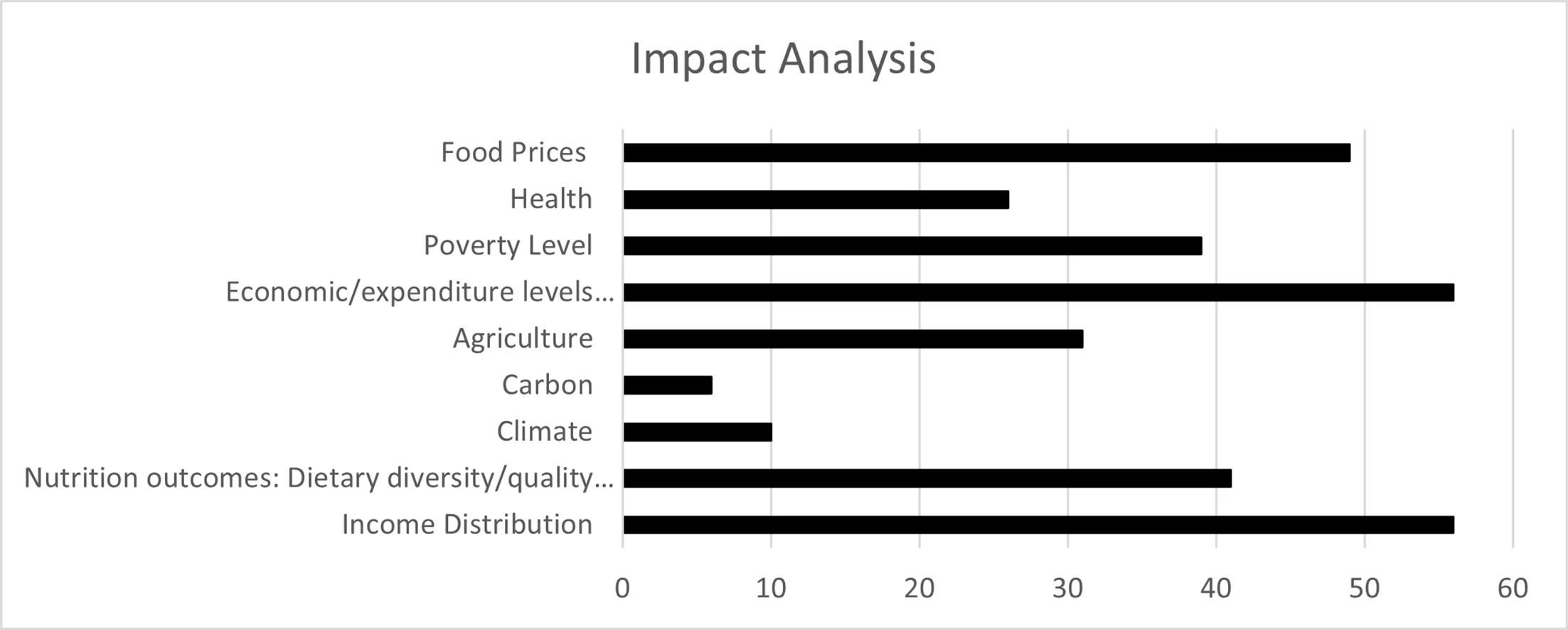
In contrast, environmental outcomes remain underexplored. Only 10 studies considered climate-related factors, and a mere 5 examined carbon emissions. These gaps are consistent with broader critiques in the literature that emphasize the lack of environmental integration in food affordability and nutrition studies. Overall, this analysis underscores the need for a more holistic approach that balances social equity, dietary quality, and ecological sustainability within microsimulation frameworks.
4.5. Drivers
Drivers shape the production, distribution, and consumption of food, and are essential for understanding food security outcomes (Ingram, 2011). These drivers span socio-economic, political, environmental, and technological domains and often interact in complex, context-specific ways. The review reveals that socio-economic factors were the most prominent, appearing in 97% of studies, underscoring the critical role of income, inequality, and livelihoods in shaping food access and affordability (Penne and Goedemé, 2021). Policy drivers were also frequently discussed (87%), reflecting the influence of taxation, subsidies, and social protection systems.
Market mechanisms and agricultural productivity were each covered in nearly half of the studies (63% and 48%, respectively) as shown in Table 4, emphasizing their role in maintaining stable and resilient food supplies (Bizimana et al., 2020; Wossen et al., 2018). Health and disease-related factors were explored in 41% of the papers, often through their link with dietary diversity and nutritional adequacy (Basu et al., 2018). Environmental and biophysical drivers including climate variability and ecosystem constraints, were less commonly examined (21%), as were supply chain logistics (20%), despite their known importance in food distribution (Hendrie et al., 2016). Although only 49% of studies engaged with consumer behaviour, these insights remain critical for explaining dietary choices and responses to policy interventions. Together, these findings highlight the need for integrated models that reflect the multi-dimensional nature of food system drivers.
| Drivers | Socio-economic and Policy Drivers | Environmental and Production Drivers | Demographic and Agricultural Drivers | Health | |||||
|---|---|---|---|---|---|---|---|---|---|
| Drivers | Socio-economic | Policy | Consumer behavior and food preferences | Markets | Bio-physical | Supply Chain | Agricultural productivity | Demographic and Spatial | Health/ Disease Factors |
| Number Papers | 59 | 53 | 30 | 49 | 13 | 12 | 29 | 23 | 25 |
| Share | 97% | 87% | 49% | 63% | 21% | 20% | 48% | 38% | 41% |
4.6. Methodological choices
The reviewed studies used diverse methodologies to explore food system challenges. Carbon modelling focused on emissions from food production to the entire value chain, considering factors like land use and transportation, with Garnett (2011) providing insights into the environmental impacts. Nutrition modelling, exemplified by Nelson et al. (2016), analysed nutrient intake and modelling methods, essential for assessing dietary patterns. The health-nutrition linkage was explored by An et al. (2022) discussing the cost and health implications of diets. Behavioural responses to policies were examined through models predicting individual and household reactions, as seen in a review by Thow et al. (2014)’s study on food policy impacts. Policy instruments were analysed for their types and modelling, with Moubarac et al. (2014) assessing health policy effectiveness. Market dynamics, including food prices and their variations, were detailed by Marzi (2021) and Smith (2010), highlighting economic influences on food security.
Furthermore, food poverty and security definitions varied, with Coates et al. (2007) reviewing different assessment approaches, emphasizing the need for clear criteria in food insecurity modelling. The integration of microsimulation with macroeconomic models, such as CGE, was a significant approach, allowing for a comprehensive analysis of both individual-level decisions and broader economic impacts, as demonstrated by Davies (2009). These methodological choices underline the complexity of food system research, showcasing the diverse tools and approaches employed to understand and address the multifaceted challenges within food security.
4.7. Nutritional modelling
Nutrient modelling plays a critical role in designing dietary interventions that address deficiencies and promote public health. As illustrated in Figure 7, research has heavily focused on modelling macronutrients, calories, protein, fat, and carbohydrates given their fundamental role in energy provision and physiological maintenance. Micronutrients such as iron, vitamin A, calcium, and folate are also frequently included due to their significance in metabolic function and disease prevention.
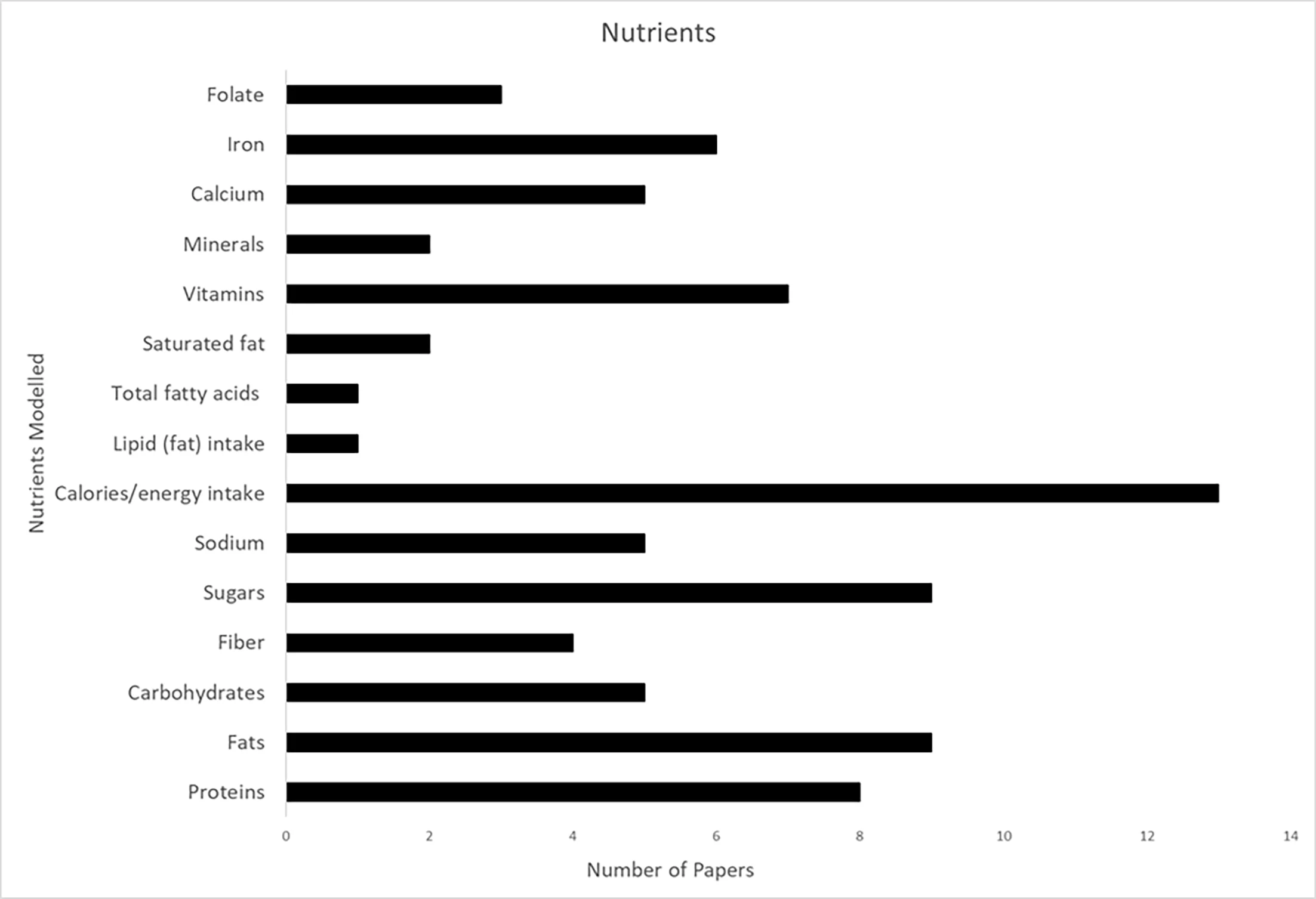
Microsimulation models have proven effective in capturing how dietary patterns and policy interventions influence nutrient intake and health outcomes. They are used to evaluate the nutritional consequences of various fiscal and regulatory measures, often targeting specific nutrients like sodium, protein, and iron. For example, Lee et al. (2020) and Pearson-Stuttard et al. (2018) simulated the impact of U.S. sodium reformulation and calorie labelling laws, respectively, demonstrating how regulatory measures shape health risks. Ecker et al. (2023) assessed beverage taxes and subsidies across multiple micronutrients, while Bizimana et al. (2020) examined nutrient adequacy and food security in Ethiopia. Other studies, such as Basu et al. (2020) on CSA programs and Viera (2023) on fiscal policy in Mexico using the GENUS model, further highlight the flexibility of microsimulation to model nutrient transitions in different contexts. Hybrid approaches, like Louhichi et al. (2020) combine CGE and microsimulation models to link economic shocks to dietary outcomes.
A key strength of the current literature lies in its emphasis on region-specific and socioeconomic targeting. For instance, Pauw et al. (2018) in Malawi and Basu et al. (2018) among Palestinian refugees underscore the value of tailoring microsimulation models to address localized nutritional vulnerabilities. This contextual precision enhances policy relevance, particularly for populations at risk of undernutrition.
However, three methodological limitations consistently constrain the nutritional fidelity of existing models. First, most simulate nutrients in isolation, overlooking well-established biochemical interactions. Pearson-Stuttard et al. (2018), for example, modeled the sodium–blood pressure–cardiovascular disease pathway without accounting for nutrient synergies, such as vitamin C’s enhancement of non-heme iron absorption, or antagonisms like calcium’s inhibition of zinc uptake. Similar omissions appear in Basu et al. (2018), which assessed iron deficiency absent vitamin C co-consumption, and Ecker et al. (2023), which neglected the effect of polyphenols on iron bioavailability. Second, many models assume uniform nutrient absorption, failing to distinguish between total intake and bioavailable fractions. Heme iron is absorbed at rates of 15–35%, while non-heme iron ranges from 2–20%, depending on dietary context. Processing methods such as milling can reduce folate content by up to 80%, while traditional practices like fermentation and nixtamalization enhance micronutrient uptake. Yet, even advanced frameworks such as GENUS (Dominguez Viera, 2023) apply static absorption rates, omitting these cultural and biological variations. Third, these technical limitations are compounded by concerns over the validity of the underlying dietary intake data. Large-scale nutrition surveys like NHANES and FFQs rely heavily on self-reported consumption, which is prone to underreporting and measurement error. Archer et al. (2013) found that NHANES caloric intake data often fell outside physiologically plausible ranges, raising questions about the reliability of these datasets for accurately modelling diet-disease relationships.
4.8. Health linked to nutrition
Robust evidence confirms that diet quality is a primary determinant of population health, especially in the context of non-communicable diseases such as obesity (Kristensen et al., 2014), type 2 diabetes, and cardiovascular conditions. Nutritional risks are among the leading contributors to global disease burden, with poor dietary patterns characterized by excess sugar, salt, and saturated fats, and insufficient fiber, fruits, and micronutrients driving chronic disease progression across all income groups. Studies by Basu et al. (2020) and Mozaffarian et al. (2018) demonstrate that improvements in diet quality can substantially reduce the incidence and severity of metabolic and cardiovascular diseases. Interventions such as sugar taxes Lee et al. (2020) and reformulation policies Shangguan et al. (2021) have shown measurable effects on population-level consumption patterns and health outcomes. Equally, targeted nutrition programs for vulnerable groups, such as those evaluated by Ramos et al. (2022) and Webb et al., 2021 highlight the potential for equity-enhancing dietary policies that reduce disparities in health access and outcomes.
MSM has been effectively applied in studies like Pearson-Stuttard et al. (2018), which modelled the effects of sugar taxation in the UK, and Javanbakht et al. (2018), which estimated avoidable healthcare costs from improved dairy consumption using a combination of review evidence and simulation in the Iranian context. Such applications highlight MSM’s unique capacity to simulate equity impacts and evaluate multisectoral food policies over time (Herman et al., 2022).
Despite its strengths, the reliability of nutrition-health models remains tied to data accuracy and assumptions about dietary behaviour. National dietary surveillance systems, such as NHANES in the U.S., have been criticized for underreporting caloric intake especially among overweight individuals and for socially undesirable foods raising concerns about the precision of health risk estimates (Archer et al., 2013). Moreover, few models adequately capture long-term behavioural adaptations, such as food substitution or diet rebound effects following policy changes. These limitations underscore the need for integrating more dynamic behaviour-response mechanisms into future models, a topic addressed in the following section. These technical constraints are further compounded by a broader limitation in scope: nutrient adequacy alone does not guarantee positive health outcomes. Factors such as bioavailability, cultural food norms, and social determinants play a critical role in shaping the health effects of dietary interventions, yet they are rarely modelled. This highlights the need for more interdisciplinary and context-sensitive approaches in future nutrition modelling.
4.9. Human behaviour response
Accurately capturing behavioural responses to fiscal food policies remains a critical methodological challenge. Predominant reliance on static price elasticities derived from cross-sectional data oversimplifies the dynamic, non-linear nature of dietary decision-making, neglecting adaptive behaviours such as cross-category substitution, habit formation, and purchasing channel shifts (An et al., 2022; Liu et al., 2020; Pauw et al., 2023). While recent microsimulation studies have introduced improvements, (Mozaffarian et al., 2018) incorporated income-stratified substitution patterns, and Liu et al. (2020) accounted for industry reformulation with behavioural compensation factors, these models often retain fixed preference structures and lack long-run dynamics. General equilibrium (CGE) models capture broader system-wide effects but assume representative agents and overlook individual heterogeneity and non-economic drivers (Ramos et al., 2022; Viera, 2023). Agent-Based Models (ABMs) offer promise by simulating social learning and network effects (Koh et al., 2019), yet face barriers in empirical calibration and policy validation.
Data limitations further constrain behavioural realism. Household Budget Surveys (HBS) often feature zero expenditures not due to abstention but temporary non-purchase (e.g., due to stockpiling or seasonal availability), leading to biased elasticity estimates if not properly addressed (Deaton and Irish, 1984; Peltner and Thiele, 2021). Censored demand models like Tobit or hurdle models, correct for this by separating participation and intensity decisions(Cragg, 1971; Shonkwiler and Yen, 1999), although cross-country application remains sensitive to survey structure and cultural norms (Kaminska and Lynn, 2017). Critically, excessive food-group aggregation further distorts behavioural inference: aggregating distinct items like yogurt and milk can mask key substitution effects, while grouping meat types together may obscure intra-category shifts under carbon pricing. Studies like Benedetti, 2022 and Caillavet et al., 2019 underscore the risks, demonstrating how disaggregated modelling reveals compensatory carbon-intensive behaviours that would otherwise be hidden. Webb et al. (2021) further show how behavioural response varies across income groups and food environments, reinforcing the need for models that better reflect consumption heterogeneity and real-world complexity.
4.10. Environmental modelling
Recent advances in modelling diet-related carbon emissions have broadened the empirical foundation for food and climate policy. A range of approaches from Environmentally Extended Input–Output (EEIO) models to Life Cycle Assessments (LCAs) and microsimulations enable emissions estimation across different stages of the food system. EEIO models, such as those used Kehlbacher et al. (2016) in a hybrid UK framework, link consumption with upstream emissions through national economic accounts. LCAs provide higher-resolution data, tracing emissions from agricultural production through to packaging and retail. Full “farm-to-fork” assessments by Benedetti (2022) reveals variations across food categories and supply chain stages that aggregate models may overlook.
Methodological diversity continues to enrich the field. Viera (2023) used the GENUS database to estimate diet-related footprints in Mexico; Anríquez and Toledo (2019) applied climate-oriented microsimulations to agricultural emissions; and Montaud et al. (2017) modeled climate scenarios to assess future impacts on productivity. These approaches enhance system understanding, especially when consumption data are integrated with upstream emissions, as in the hybrid models of Benedetti (2022) and Kehlbacher et al. (2016).
Yet significant limitations persist. System boundaries remain inconsistently defined: many studies end at retail or focus only on agriculture omitting stages like processing, cooking, and food waste that materially affect total emissions. GHG coverage also varies; while some models capture only CO₂, others include methane and nitrous oxide which they are key contributors in livestock and fertilizer systems (Cororaton et al., 2015). These omissions compromise comparability and accuracy.
Methodological inconsistency further hinders synthesis. Emission factor sources, allocation rules, functional units (e.g., per kg, per calorie or per monetary unit), and data inputs differ widely from national accounts (Viera, 2023) to primary farm surveys. EEIO models often aggregate dissimilar products masking variation in carbon intensity. LCAs, though more precise, often rely on case-specific data, making it difficult to generalize results across diverse consumption settings or national dietary patterns.
Going forward, standardized frameworks are essential. These should mandate full life cycle coverage, consistent GHG accounting, and harmonized data inputs. Hybrid models that integrate EEIO’s macro scope with LCA’s granularity offer a promising path. As shown by Benedetti (2022), combining dietary behaviour with food system dynamics is crucial for capturing both direct and indirect emissions impacts.
4.11. Food poverty and food security modelling
Understanding the determinants of household food security requires modelling frameworks that integrate socioeconomic, nutritional, and systemic dimensions. Existing studies employ a range of methodologies to quantify availability, access, and affordability, yet aggregate-level models often emphasize macro trends at the expense of household-level vulnerabilities. For instance, Koh et al. (2019) modelled disparities in food access via household consumption data, while Gasior et al. (2022) used sectoral economic indicators to assess poverty dynamics in Zambia. By contrast, Harttgen et al. (2016) applied a micro-based simulation model using household survey data from Malawi to assess how income and staple food price shocks impact calorie availability and food poverty. While their approach captures short-term household-level vulnerabilities more effectively than aggregate models, it still does not account for broader aspects of nutritional adequacy or long-term health risks.
Targeted modelling techniques have emerged to address these limitations by incorporating direct measures of food insecurity and poverty. operationalized food security through calorie-based thresholds to estimate the “food poor,” while Arndt et al. (2023) linked nutrient deficiencies to poverty via comparisons between dietary intakes and recommended guidelines. Microsimulation models offer critical granularity by embedding household-level data within broader economic structures. Cororaton et al. (2015), for example, combined computable general equilibrium (CGE) models with microsimulation to trace income shocks to poverty indicators such as the headcount ratio, thereby capturing the distributional consequences of policy or crisis scenarios.
The evolution toward integrated modelling reflects the growing need for multidimensional analysis. Beyene and Engida (2016) linked CGE and household modules to assess the poverty and production impacts of economy-wide shocks. Similarly, Mamboundou (2022) introduced a composite index encompassing availability, access, and vulnerability to evaluate food system resilience. These developments underscore microsimulation’s unique role in translating macro-level changes into household-level outcomes, ensuring that policy assessments reflect both structural drivers and individual-level deprivation.
Nonetheless, many food policy models remain narrowly focused on calorie sufficiency () or minimum nutrient thresholds (Arndt et al., 2023), often overlooking essential dimensions of food security such as dietary diversity, food safety, and intra-household distribution. They also neglect feedback loops linking nutrition, health, and earning capacity. Even when affordability is considered, models like Koh et al. (2019), which examine the cost of a nutritious basket, typically ignore seasonal variation, price volatility, and behavioural adaptation. Integrated modelling frameworks that combine Computable General Equilibrium (CGE) models with microsimulation, as demonstrated by, provide a more nuanced assessment of policy impacts by linking macroeconomic shifts with household-level outcomes. However, these models are computationally demanding and can be difficult for non-technical stakeholders to interpret, raising concerns about transparency and replicability. Additionally, their reliance on assumptions about future variables, such as prices, climate conditions, and behavioural responses introduces inherent uncertainty. While sensitivity analyses can help test the robustness of results, this uncertainty cannot be fully eliminated and must be transparently communicated to ensure credible and policy-relevant conclusions.
4.12. Macro–micro analysis
Integrated macro-micro models, which link Computable General Equilibrium (CGE) frameworks with microsimulation, offer a robust method for evaluating how economy-wide shocks influence household food security. CGE models simulate the effects of macro-level disturbances such as trade changes or fertilizer shortages on sectoral prices, wages, and production outputs (Ayaz et al., 2022; Ha et al., 2015; Nechifor et al., 2021; Yang et al., 2018). These results are then transmitted to microsimulation models, allowing analysts to estimate the household-level impacts on income, consumption, and poverty (Debela and Tamiru, 2016; Viera, 2023). Most applications follow a top-down structure, where CGE-derived changes in prices and incomes are applied to household survey data, capturing the distributional consequences across different household types and regions (Beyene and Engida, 2016; Cororaton et al., 2015; Mamboundou, 2022; Aragie et al., 2023; Mengistu, 2013; Muhammad et al., 2023; Tekle and Simane, 2014Tekle and Simane, 2014; Wiebelt et al., 2013).
To reflect household heterogeneity, microsimulations adjust expenditures based on commodity-specific price changes and update incomes using sectoral wage and return shifts. These adjustments are tailored to each household’s unique consumption and income profile. In more advanced applications, feedback mechanisms are introduced. For example, Otchia (2019) models labor supply decisions at the household level and feeds those responses back into the CGE model, allowing for iterative recalibration. Other refinements include greater spatial detail; Ramos et al. (2022) apply region-specific CGE outputs in their microsimulations, while Viera (2023) incorporates municipal-level price variation to improve geographic accuracy.
Despite their strengths, integrated macro-micro models face several limitations. Many remain static and do not fully capture behavioural adaptations such as crop switching, labor reallocation, or depletion of savings. Technical challenges also arise in harmonizing household and CGE data, ensuring mapping consistency, and resolving convergence issues (Savard, 2003). Informal sectors, often absent from Social Accounting Matrices, are typically excluded, limiting coverage of key livelihood channels. Moreover, the results can be sensitive to modelling assumptions such as closure rules and sectoral classifications (Ahmed and O’Donoghue, 2007). Nevertheless, when these models incorporate iterative feedback and behavioural realism, they remain among the most effective tools for analysing the distributional and nutritional implications of macro-level shocks in food systems (Nechifor et al., 2021; Otchia, 2019).
4.13. Policy instruments and analysis
Microsimulation has become central to evaluating food policy impacts on household welfare, nutrition, and equity. It enables detailed modelling of how interventions, such as food subsidies (32 studies), input support (23), and cash transfers (24) affect consumption and affordability across income groups as shown in Figure 8. By leveraging household survey data and consumption patterns, microsimulation reveals distributional impacts that aggregate models often miss. Basu et al. (2013) modelled SNAP benefit increases to assess calorie adequacy. Bundled policy simulations, like Ecker et al. (2023) work on fortification with income support, further demonstrate microsimulation’s value in testing realistic, multi-pronged reforms.
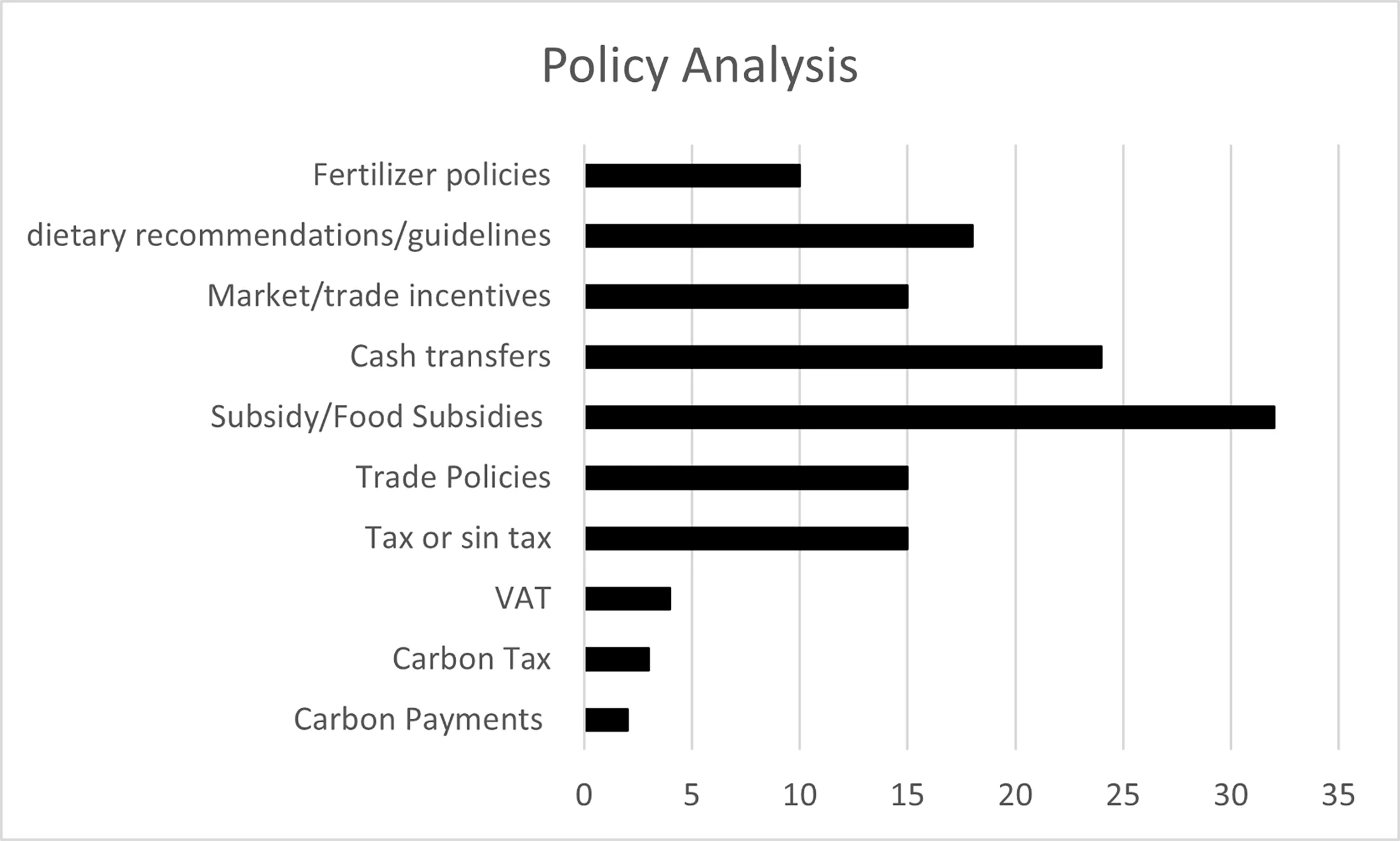
Its strength lies in flexibility. Microsimulation incorporates price elasticities, nutrient needs, and behavioral responses to project outcomes across nutrition, fiscal costs, and environmental effects. Studies on dietary guidelines (18), VAT reforms (Harris et al., 2018; O’Donoghue et al., 2018), and warning labels (An et al., 2022) use behavioral data to simulate policy uptake. Broader reforms including trade policies (15) are also captured, revealing how market shifts cascade to household diets. Abuelhaj (2018) applied microsimulation to assess taxation and subsidy policies in the MENA region, emphasizing nutrition-sensitive outcomes. Caillavet et al. (2019) demonstrated that pairing taxes with revenue recycling can mitigate but not eliminate equity concerns, highlighting microsimulation’s capacity to quantify persistent trade-offs under real-world constraints.
Yet, major limitations remain. Most models are static, overlooking behavioral adaptation and long-term effects. Fertilizer policy simulations rarely consider evolving market prices, and transfer programs often ignore changes in household participation over time. Carbon and sin taxes, though modeled in a handful of studies, are rarely validated against real-world outcomes. Geographic granularity is limited, with rural-urban divides and informal food systems often absent. Strengthening microsimulation requires dynamic feedback, finer spatial resolution, and validation against observed responses to ensure MSM not only informs but also reflect policy reality.
5. Discussion
Food system MSM faces a pressing imperative: to simultaneously address environmental sustainability, nutritional adequacy, and economic affordability. While microsimulation (MSM) and integrated macro–micro (CGE-MSM) models have advanced understanding of each domain, they are often applied in isolation, limiting their ability to reflect real-world interdependencies. Nutritional MSM tend to overlook cultural dietary norms and nutrient bioavailability; environmental assessments frequently omit critical stages like processing and food waste; and economic MSM often reduce complex diets to calorie-based metrics. Notably, the environmental dimension remains comparatively understudied in food policy MSM, with limited integration of greenhouse gas emissions, biodiversity impacts, and land-use trade-offs. This fragmentation risks generating counterproductive policies for instance, carbon taxes that reduce emissions yet worsen malnutrition by making nutrient-rich foods less affordable for low-income households.
Integrating these dimensions reveals both synergies and trade-offs (Al-Masbhi et al., 2026). Well-designed environmental policies, such as emissions-based subsidies, can support climate-resilient, nutrient-dense crops like pulses and agroforestry species, simultaneously enhancing soil health and household nutrition. Conversely, poorly calibrated interventions may undermine health and equity. Broad-based meat taxes, while effective in reducing emissions, risk exacerbating zinc and iron deficiencies in vulnerable populations. Similarly, efforts to decarbonize supply chains can increase the cost of perishable vegetables, limiting access to essential micronutrients. The risk of carbon leakage where production shifts to less-regulated regions further compounds the problem by increasing reliance on imported, ultra-processed foods that are low in nutritional value and high in emissions (OECD, 2025).
To navigate these complexities, hybrid modelling approaches are essential. On the environmental front, combining detailed Life Cycle Assessment (LCA) with economy-wide Input–Output (IO) analysis enables both product-level specificity and system-wide coverage, supporting standardized GHG accounting across the full value chain (Hagenaars et al., 2025). Nutritional MSM should go beyond static nutrient counts to incorporate bioavailability, dietary diversity, and cultural relevance (Farfán et al., 2017). On the economic side, fiscal policies such as carbon taxes or VAT reforms must be accompanied by redistributive mechanisms like targeted food subsidies or cash transfers to shield vulnerable households from regressive impacts. Empirical evidence from Caillavet et al. (2019) illustrates how recycling carbon revenues to subsidize low-emission, protein-rich foods like legumes can enhance both dietary equity and environmental outcomes.
Model design choices critically influence policy relevance. MSM excels at capturing household-level heterogeneity, including differences in consumption patterns, poverty exposure, and nutritional risk. CGE-MSM frameworks extend this by linking micro-outcomes to macroeconomic dynamics such as price volatility and climate shocks. However, most CGE-MSM models adopt a top-down structure transmitting aggregate shocks to households while often neglecting bottom-up feedback, including behavioural responses and informal coping mechanisms that can meaningfully affect macro outcomes. Consequently, many models continue to rely on static price elasticities and assume average household behaviour, overlooking behavioural adaptation, informal food economies, and localized vulnerabilities. This limits their capacity to represent the complexity of food system dynamics. A layered modelling strategy starting with tractable assumptions and incrementally adding complexitycan help identify the most influential variables, such as price changes, yield shocks, and consumer substitution, while enhancing transparency and contextual relevance.
Data quality remains a fundamental constraint. Dietary intake is often derived from food frequency questionnaires or 24-hour recalls, both of which suffer from recall bias, seasonal variability, and systematic underreporting especially among low-income populations (Harrison et al., 2000). These tools rarely account for food consumed outside the home or shared within households, leading to underestimation of true nutrient intake and inequality in access (Shim et al., 2014). Furthermore, national datasets frequently record food purchases rather than actual consumption, overlooking losses from spoilage, cooking, and intra-household distribution. Nutrient composition databases further obscure accuracy by assuming uniformity across food types and preparation methods, disregarding bioavailability differences. Addressing these gaps requires more frequent and disaggregated dietary surveys, harmonized data systems, and better integration across nutrition, expenditure, and environmental metrics.
Ultimately, advancing food system MSM means constructing frameworks that reflect the complex interplay of health, climate, and inequality. This calls for standardized emissions accounting protocols, context-sensitive nutrient modelling, and affordability mechanisms embedded into fiscal design. It also demands modular modelling tools, robust behavioural assumptions, and interdisciplinary collaboration across public health, environmental science, and economic policy. Only by confronting these layers of complexity directly can MSM inform actionable, equitable, and sustainable transformations in food systems.
5.1. Modelling validation
Validating microsimulation outputs is difficult, especially for ex-ante scenarios where no real-world outcomes exist. While aggregate data such as national food emissions are available, they rarely align with household-level consumption. Household Budget Survey (HBS) data also pose challenges due to limited coverage, underreporting, and definitional mismatches with official statistics. Even for existing policies, these differences complicate benchmarking.
Model validation in food and nutrition MSM remains uneven, with many studies offering limited transparency or empirical verification. A few set strong examples, (Basu et al., 2020; Basu et al., 2013; Basu et al., 2018; Lee et al., 2020), for instance, combine calibration with real-world datasets such as NHANES and SNAP trial results, while also conducting sensitivity analyses. Similarly, Wossen et al. (2018) and James et al. (2019) validate model predictions against household survey data on poverty and expenditure, showing strong alignment. Yet, such robust validation remains the exception rather than the norm.
In most cases, validation is either internal or purely theoretical, especially in studies constrained by data availability. Grieger et al. (2017), for example, calibrated their model to national dietary survey data and explored energy compensation scenarios. However, others such as Ecker et al. (2023) and Boulanger et al. (2022) offer no clear validation steps. Even widely cited models like Nechifor et al. (2021), developed to assess COVID-19 impacts, fall short of comparing projections with real-world outcomes limiting the confidence that policymakers can place in their results.
Across the literature, baseline calibration and sensitivity testing are common, but few MSM go further to conduct external validation. Metrics such as RMSE or R² are rarely reported, and when established models are reused like US IMPACT or CVD-PREDICT, they are not always adapted or revalidated for new settings (Jardim et al., 2019; Otchia, 2019). Validation protocols are often poorly documented, buried in supplementary materials or omitted altogether. These challenges are especially pronounced in resource-limited settings, where studies from Ethiopia (Mengistu, 2013) and Malawi (Ngoleka, 2013) rely on theoretical calibration due to a lack of empirical data.
The absence of robust and transparent validation can undermine the credibility and usefulness of MSM for policy design. By contrast, validated models such as Mozaffarian et al. (2018) provide stronger and more reliable evidence for policy interventions. Going forward, studies should adopt multi-pronged validation strategies combining calibration, benchmarking with observed data, and sensitivity testing. In settings where data are scarce, consistency checks with deprivation indices or input from local stakeholders can help improve contextual accuracy. Clear documentation, supported by reporting standards like CHEERS (Lee et al., 2020), is essential to enhance trust, comparability, and policy relevance
6. Conclusion
We argued at the beginning of this article that food security must be understood as a multidimensional challenge shaped by the interplay of affordability, nutrition, environmental sustainability, and behaviour. This review, based on 60 studies using MSM, reveals that current literature often treats these dimensions in isolation. This fragmented approach limits the effectiveness of policy design and fails to reflect the systemic trade-offs inherent in real-world food systems.
The findings underscore three critical gaps: the marginal treatment of environmental impacts, the underrepresentation of behavioural dynamics, and the persistent separation of policy domains. While affordability and nutrition dominate research and policy agendas, environmental sustainability and consumer behaviour are too often sidelined. This is especially problematic in light of climate change and evolving dietary patterns. By synthesizing studies that integrate simulation and systems-based methods, this review identifies opportunities to build models that better capture interdependencies across domains particularly in contexts of carbon pricing, dietary transition, and environmental metrics.
One notable challenge lies in the quality and harmonization of data. Most studies rely on household-level data from budget surveys, which offer useful expenditure information but lack granularity on actual intake and behaviour. Individual dietary surveys provide richer insights but suffer from issues like recall bias and limited coverage. These limitations highlight the need for improved survey design, cross-national comparability, and greater access to harmonized microdata to support robust MSM.
This review contributes a novel perspective by tracing the evolution of food security MSM across economic, environmental, and health dimensions. It calls for greater interdisciplinarity, deeper attention to behavioural factors, and integrated data infrastructures. If policymakers were to take these findings seriously, it could support the shift from siloed interventions to system-based strategies that align hunger reduction, health promotion, and climate goals moving us closer to a sustainable and equitable food future.
References
- Abdul Hakim, Md (2018). Simulating the nutritional traits of populations at the small area levels using spatial microsimulation modelling approach. Computational Biology and Bioinformatics, 6. https://doi.org/10.11648/j.cbb.20180601.13
- Aborisade, B, Bach, C (2014). Assessing the pillars of sustainable food security. European International Journal of Science and Technology, 3, 117–125.
- Abu, B, Oldewage-Theron, W (2019). Food insecurity among college students in West Texas. British Food Journal, 121, 738–754. https://doi.org/10.1108/BFJ-12-2018-0804
- (2018). Food security policy impact analysis: the econometrics of cash and food assistance cost effectiveness. Maastricht University.
- Adams, J, Hillier-Brown, FC, Moore, HJ, Lake, AA, Araujo-Soares, V, White, M, Summerbell, C (2016). Searching and synthesising “grey literature” and “grey information” in public health: critical reflections on three case studies. Systematic Reviews, 5. https://doi.org/10.1186/s13643-016-0337-y
- Ahmed, V, O’Donoghue, C (2007). CGE-microsimulation modelling: A survey.
- Al-Masbhi, G, O’Donoghue, C, Sologon, DM (2026). Food Carbon Taxation and Distributional Equity: Comparing LCA and IO Approaches.
- An, R, Zheng, J, Xiang, X (2022). Projecting the influence of sugar-sweetened beverage warning labels and restaurant menu labeling regulations on energy intake, weight status, and health care expenditures in US Adults: a microsimulation. Journal of the Academy of Nutrition and Dietetics, 122, 334–344. https://doi.org/10.1016/j.jand.2021.05.006
- Anríquez, G, Toledo, G (2019). De-climatizing food security: Lessons from climate change micro-simulations in Peru. PLOS One, 14. https://doi.org/10.1371/journal.pone.0222483
- Antle, JM, Capalbo, SM (2017). In The Economics of Land Use.
- Aragie, E, Balié, J, Morales, C, Pauw, K (2023). Synergies and trade-offs between agricultural export promotion and food security: Evidence from African economies. World Development, 172. https://doi.org/10.1016/j.worlddev.2023.106368
- Archer, E, Hand, GA, Blair, SN (2013). Validity of U.S. nutritional surveillance:National Health and Nutrition Examination Survey caloric energy intake data, 1971-2010. PLOS One, 8. https://doi.org/10.1371/journal.pone.0076632
- Arndt, C, Diao, X, Dorosh, P, Pauw, K, Thurlow, J (2023). The Ukraine war and rising commodity prices: Implications for developing countries. Global Food Security, 36. https://doi.org/10.1016/j.gfs.2023.100680
- Ayaz, M, Sers, CF, Maisonnave, H, Mughal, M (2022). Echo of the Cannons? Economic Impact of the Ukraine War on Pakistan-A Macro-Micro Simulation Analysis. HAL open science.
- Ballas, D, Clarke, G, Hynes, S, Lennon, J, Morrissey, K, Donoghue, C (2013). Spatial Microsimulation for Rural Policy Analysis.
- Barrett, CB, Lentz, E (2015). Food Insecurity and Food Aid in Africa. SSRN.
- Bartolucci, AA, Hillegass, WB (2010). Evidence-Based Practice: Toward Optimizing Clinical Outcomes.
- Basu, S, Seligman, H, Bhattacharya, J (2013). Nutritional policy changes in the supplemental nutrition assistance program: a microsimulation and cost-effectiveness analysis. Medical Decision Making, 33, 937–948.
- Basu, S, Yudkin, JS, Berkowitz, SA, Jawad, M, Millett, C (2018). Reducing chronic disease through changes in food aid: A microsimulation of nutrition and cardiometabolic disease among Palestinian refugees in the Middle East. PLOS Medicine, 15. https://doi.org/10.1371/journal.pmed.1002700
- Basu, S, O’Neill, J, Sayer, E, Petrie, M, Bellin, R, Berkowitz, SA (2020). Population health impact and cost-effectiveness of community-supported agriculture among low-income US adults: a microsimulation analysis. American Journal of Public Health, 110, 119–126. https://doi.org/10.2105/AJPH.2019.305364
- Behrens, P, Kiefte-de Jong, JC, Bosker, T, Rodrigues, JFD, de Koning, A, Tukker, A (2017). Evaluating the environmental impacts of dietary recommendations. PNAS, 114, 13412–13417. https://doi.org/10.1073/pnas.1711889114
- Béné, C (2020). Resilience of local food systems and links to food security - A review of some important concepts in the context of COVID-19 and other shocks. Food Security, 12, 805–822. https://doi.org/10.1007/s12571-020-01076-1
- (2022). Environmental Regulation and Sustainability in the Food Sector: Exploring the Impact of Carbon Taxation on Diets, Health and Trade in UK (Doctoral dissertation). Newcastle University.
- Beyene, LM, Engida, E (2016). Public investment in irrigation and training, growth and poverty reduction In Ethiopia. International Journal of Microsimulation, 9, 1–4. https://doi.org/10.34196/ijm.00129
- Bizimana, J-C, Richardson, JW, Clarke, NP (2020). Household food security and nutrition analysis using a farm simulation model (farmsim): case study of robit in amhara region, Ethiopia. ES Food & Agroforestry, 2, 22–41. https://doi.org/10.30919/esfaf1113
- Boell, SK, Cecez-Kecmanovic, D (2014). A hermeneutic approach for conducting literature reviews and literature searches. Communications of the Association for Information Systems, 34. https://doi.org/10.17705/1CAIS.03412
- Boulanger, P, Dudu, H, Ferrari, E, Mainar-Causapé, AJ, Ramos, MP (2022). Effectiveness of fertilizer policy reforms to enhance food security in Kenya: a macro–micro simulation analysis. Applied Economics, 54, 841–861. https://doi.org/10.1080/00036846.2020.1808180
- Braun, V, Teklu, J, Webb, T (1999). Famine in Africa: Causes, Responses, and Prevention. Intl Food Policy Res Inst.
- Breisinger, C, Ecker, O (2014). Simulating economic growth effects on food and nutrition security in Yemen: A new macro–micro modeling approach. Economic Modelling, 43, 100–113. https://doi.org/10.1016/j.econmod.2014.07.029
- Briones Alonso, E, Cockx, L, Swinnen, J (2018). Culture and food security. Global Food Security, 17, 113–127. https://doi.org/10.1016/j.gfs.2018.02.002
- Brown, L (2011). Editorial special issue on ‘Health and Microsimulation’. International Journal of Microsimulation, 4, 1–2. https://doi.org/10.34196/ijm.00055
- Buslei, H, Bach, S, Simmler, M (2014). Firm Level Models Specifically Firm Models based upon large data sets. In Handbook of Microsimulation Modelling, 479–503. https://doi.org/10.1108/S0573-855520140000293015
- Caillavet, F, Fadhuile, A, Nichèle, V (2019). Assessing the distributional effects of carbon taxes on food: Inequalities and nutritional insights in France. Ecological Economics, 163, 20–31. https://doi.org/10.1016/j.ecolecon.2019.04.020
- Choi, SE, Wright, DR, Bleich, SN (2021). Impact of restricting sugar-sweetened beverages from the supplemental nutrition assistance program on children’s health. American Journal of Preventive Medicine, 60, 276–284. https://doi.org/10.1016/j.amepre.2020.08.023
- Clapp, J, Moseley, WG, Burlingame, B, Termine, P (2022). Viewpoint: The case for a six-dimensional food security framework. Food Policy, 106. https://doi.org/10.1016/j.foodpol.2021.102164
- Coates, J, Swindale, A, Bilinsky, P (2007). Household Food Insecurity Access Scale (HFIAS) for measurement of food access indicator guide: Version 3.
- Cockburn, J, Corong, E, Cororaton, C (2010). Integrated computable general equilibrium (CGE) micro-simulation approach. International Journal of Microsimulation, 3, 60–71. https://doi.org/10.34196/ijm.00025
- Cohen, MJ, Garrett, JL (2010). The food price crisis and urban food (in)security. Environment and Urbanization, 22, 467–482. https://doi.org/10.1177/0956247810380375
- Cororaton, C, Inocencio, A, Siriban-Manalang, AB, Tiongco, M (2015). A conceptual framework for estimating the impact of climatic uncertainty and shocks on land use, food production, and poverty in the Philippines.
- Cragg, JG (1971). Some statistical models for limited dependent variables with application to the demand for durable goods. Econometrica, 39. https://doi.org/10.2307/1909582
- Cucagna, ME, Goldsmith, PD (2018). Value adding in the agri-food value chain. International Food and Agribusiness Management Review, 21, 293–316. https://doi.org/10.22434/IFAMR2017.0051
- Darmon, N, Drewnowski, A (2015). Contribution of food prices and diet cost to socioeconomic disparities in diet quality and health: a systematic review and analysis. Nutrition Reviews, 73, 643–660. https://doi.org/10.1093/nutrit/nuv027
- Dave, LA, Hodgkinson, SM, Roy, NC, Smith, NW, McNabb, WC (2023). The role of holistic nutritional properties of diets in the assessment of food system and dietary sustainability. Critical Reviews in Food Science and Nutrition, 63, 5117–5137. https://doi.org/10.1080/10408398.2021.2012753
- de Oliveira, DCRS, de Moura Souza, A, Levy, RB, Sichieri, R, Verly-Jr, E (2019). Comparison between household food purchase and individual food consumption in Brazil. Public Health Nutrition, 22, 841–847. https://doi.org/10.1017/S1368980018002987
- Davies, JB (2009). Combining microsimulation with CGE and macro modelling for distributional analysis in developing and transition countries. International Journal of Microsimulation, 2, 49–56. https://doi.org/10.34196/ijm.00011
- Deaton, A, Irish, M (1984). Statistical models for zero expenditures in household budgets. Journal of Public Economics, 23, 59–80. https://doi.org/10.1016/0047-2727(84)90067-7
- Deaton, AS (2005). Franco Modigliani and the Life Cycle Theory of Consumption.
- Debela, GM, Tamiru, S (2016). In Poverty and Well-Being in East Africa: A Multi-Faceted Economic Approach.
- Debowicz, D (2016). Does the microsimulation approach used in macro–micro modelling matter? An application to the distributional effects of capital outflows during Argentina’s Currency Board regime. Economic Modelling, 54, 591–599. https://doi.org/10.1016/j.econmod.2016.01.018
- Diao, X, Dorosh, PA, Thurlow, J (2022). Rwanda: Impacts of the Ukraine and global crises on poverty and food security. Rwanda: Impacts of the Ukraine and global crises on poverty and food security.
- Drew, J, Cleghorn, C, Macmillan, A, Mizdrak, A (2020). Healthy and climate-friendly eating patterns in the New Zealand context. Environmental Health Perspectives, 128.
- Ecker, O, Alderman, H, Comstock, AR, Headey, DD, Mahrt, K, Pradesha, A (2023). Mitigating poverty and undernutrition through social protection: A simulation analysis of the COVID ‐19 pandemic in Bangladesh and Myanmar. Applied Economic Perspectives and Policy, 45, 2034–2055. https://doi.org/10.1002/aepp.13357
- Eliasson, G (1991). Modeling the experimentally organized economy: complex dynamics in an empirical micro-macro model of endogenous economic growth. Journal of Economic Behavior & Organization, 16, 153–182. https://doi.org/10.1016/0167-2681(91)90047-2
- Ellegaard, O, Wallin, JA (2015). The bibliometric analysis of scholarly production: how great is the impact?. Scientometrics, 105, 1809–1831. https://doi.org/10.1007/s11192-015-1645-z
- Farfán, G, Genoni, ME, Vakis, R (2017). You are what (and where) you eat: capturing food away from home in welfare measures. Food Policy, 72, 146–156. https://doi.org/10.1016/j.foodpol.2017.08.020
- Garnett, T (2011). Where are the best opportunities for reducing greenhouse gas emissions in the food system (including the food chain)?. Food Policy, 36, S23–S32. https://doi.org/10.1016/j.foodpol.2010.10.010
- Gasior, K, Navarro, S, Pirttilä, J, Kangasniemi, M (2022). Distributional impacts of agricultural policies in Zambia: a microsimulation approach.
- Gibson, RS, Perlas, L, Hotz, C (2006). Improving the bioavailability of nutrients in plant foods at the household level. The Proceedings of the Nutrition Society, 65, 160–168. https://doi.org/10.1079/pns2006489
- Godfray, HCJ, Beddington, JR, Crute, IR, Haddad, L, Lawrence, D, Muir, JF, Pretty, J, Robinson, S, Thomas, SM, Toulmin, C (2010). Food security: the challenge of feeding 9 billion people. Science, 327, 812–818. https://doi.org/10.1126/science.1185383
- Green, R, Milner, J, Dangour, AD, Haines, A, Chalabi, Z, Markandya, A, Spadaro, J, Wilkinson, P (2015). The potential to reduce greenhouse gas emissions in the UK through healthy and realistic dietary change. Climatic Change, 129, 253–265. https://doi.org/10.1007/s10584-015-1329-y
- Greenhalgh, T, Peacock, R (2005). Effectiveness and efficiency of search methods in systematic reviews of complex evidence: audit of primary sources. BMJ, 331, 1064–1065. https://doi.org/10.1136/bmj.38636.593461.68
- Grieger, JA, Johnson, BJ, Wycherley, TP, Golley, RK (2017). Comparing the nutritional impact of dietary strategies to reduce discretionary choice intake in the australian adult population: a simulation modelling study. Nutrients, 9. https://doi.org/10.3390/nu9050442
- Ha, PV, Nguyen, HTM, Kompas, T, Che, TN, Trinh, B (2015). Rice production, trade and the poor: regional effects of rice export policy on households in Vietnam. Journal of Agricultural Economics, 66, 280–307. https://doi.org/10.1111/1477-9552.12087
- Hagenaars, RH, Heijungs, R, Tukker, A, Wang, R (2025). Hybrid LCA for sustainable transitions: principles, applications, and prospects. Renewable and Sustainable Energy Reviews, 212. https://doi.org/10.1016/j.rser.2025.115443
- Harris, T, Phillips, D, Warwick, R, Goldman, M, Jellema, J, Goraus-Tanska, K, Inchauste, G (2018). Redistribution via VAT and Cash Transfers: An Assessment in Four Low and Middle Income Countries. IFS Working Papers.
- Harrison, GG, Galal, OM, Ibrahim, N, Khorshid, A, Stormer, A, Leslie, J, Saleh, NT (2000). Underreporting of food intake by dietary recall is not universal: a comparison of data from egyptian and american women. The Journal of Nutrition, 130, 2049–2054. https://doi.org/10.1093/jn/130.8.2049
- Harttgen, K, Klasen, S, Rischke, R (2016). Analyzing nutritional impacts of price and income related shocks in Malawi: Simulating household entitlements to food. Food Policy, 60, 31–43. https://doi.org/10.1016/j.foodpol.2015.03.007
- Hawkes, C, Ruel, MT, Salm, L, Sinclair, B, Branca, F (2020). Double-duty actions: seizing programme and policy opportunities to address malnutrition in all its forms. The Lancet, 395, 142–155. https://doi.org/10.1016/S0140-6736(19)32506-1
- Headey, DD, Oo, TZ, Mahrt, K, Diao, X, Goudet, S, Lambrecht, I (2020). Poverty and food insecurity during COVID-19: Phone-survey evidence from rural and urban Myanmar in 2020.
- Heller, MC, Willits-Smith, A, Meyer, R, Keoleian, GA, Rose, D (2018). Greenhouse gas emissions and energy use associated with production of individual self-selected US diets. Environmental Research Letters, 13. https://doi.org/10.1088/1748-9326/aab0ac
- Hendrie, GA, Baird, D, Ridoutt, B, Hadjikakou, M, Noakes, M (2016). Overconsumption of energy and excessive discretionary food intake inflates dietary greenhouse gas emissions in Australia. Nutrients, 8. https://doi.org/10.3390/nu8110690
- Herman, PM, Nguyen, P, Sturm, R (2022). Diet quality improvement and 30-year population health and economic outcomes: a microsimulation study. Public Health Nutrition, 25, 1265–1273. https://doi.org/10.1017/S136898002100015X
- Hurrell, R, Egli, I (2010). Iron bioavailability and dietary reference values. The American Journal of Clinical Nutrition, 91, 1461S–1467S. https://doi.org/10.3945/ajcn.2010.28674F
- Immervoll, H, O’Donoghue, C (2009). Towards a multi-purpose framework microsimulation: lessons from EUROMOD. International Journal of Microsimulation, 2, 43–54. https://doi.org/10.34196/ijm.00016
- Ingram, J (2011). A food systems approach to researching food security and its interactions with global environmental change. Food Security, 3, 417–431. https://doi.org/10.1007/s12571-011-0149-9
- James, WH, Lomax, N, Birkin, M (2019). Local level estimates of food, drink and tobacco expenditure for Great Britain. Scientific Data, 6.
- Jardim, TV, Mozaffarian, D, Abrahams-Gessel, S, Sy, S, Lee, Y, Liu, J, Huang, Y, Rehm, C, Wilde, P, Micha, R, Gaziano, TA (2019). Cardiometabolic disease costs associated with suboptimal diet in the United States: A cost analysis based on a microsimulation model. PLOS Medicine, 16. https://doi.org/10.1371/journal.pmed.1002981
- Javanbakht, M, Jamshidi, AR, Baradaran, HR, Mohammadi, Z, Mashayekhi, A, Shokraneh, F, Rezai Hamami, M, Yazdani Bakhsh, R, Shabaninejad, H, Delavari, S, Tehrani, A (2018). Estimation and prediction of avoidable health care costs of cardiovascular diseases and type 2 diabetes through adequate dairy food consumption: a systematic review and micro simulation modeling study. Archives of Iranian Medicine, 21, 213–222.
- Jones, AD, Ngure, FM, Pelto, G, Young, SL (2013). What are we assessing when we measure food security? A compendium and review of current metrics. Advances in Nutrition, 4, 481–505. https://doi.org/10.3945/an.113.004119
- Kahneman, D, Tversky, A (1979). Prospect theory: an analysis of decision under risk. Econometrica, 47. https://doi.org/10.2307/1914185
- Kaminska, O, Lynn, P (2017). Survey-based cross-country comparisons where countries vary in sample design: issues and solutions. Journal of Official Statistics, 33, 123–136. https://doi.org/10.1515/jos-2017-0007
- Kehlbacher, A, Tiffin, R, Briggs, A, Berners-Lee, M, Scarborough, P (2016). The distributional and nutritional impacts and mitigation potential of emission-based food taxes in the UK. Climatic Change, 137, 121–141. https://doi.org/10.1007/s10584-016-1673-6
- Kivunja, C (2018). Distinguishing between theory, theoretical framework, and conceptual framework: a systematic review of lessons from the field. International Journal of Higher Education, 7. https://doi.org/10.5430/ijhe.v7n6p44
- Klenert, D, Funke, F, Cai, M (2023). Meat taxes in Europe can be designed to avoid overburdening low-income consumers. Nature Food, 4, 894–901. https://doi.org/10.1038/s43016-023-00849-z
- Koh, K, Reno, R, Hyder, A (2019). Examining disparities in food accessibility among households in Columbus, Ohio: an agent-based model. Food Security, 11, 317–331. https://doi.org/10.1007/s12571-019-00900-7
- Kristensen, AH, Flottemesch, TJ, Maciosek, MV, Jenson, J, Barclay, G, Ashe, M, Sanchez, EJ, Story, M, Teutsch, SM, Brownson, RC (2014). Reducing childhood obesity through U.S. federal policy: a microsimulation analysis. American Journal of Preventive Medicine, 47, 604–612. https://doi.org/10.1016/j.amepre.2014.07.011
- Lee, Y, Mozaffarian, D, Sy, S, Liu, J, Wilde, PE, Marklund, M, Abrahams-Gessel, S, Gaziano, TA, Micha, R (2020). Health impact and cost-effectiveness of volume, tiered, and absolute sugar content sugar-sweetened beverage tax policies in the United States: a microsimulation study. Circulation, 142, 523–534. https://doi.org/10.1161/CIRCULATIONAHA.119.042956
- Lee, Y, Mozaffarian, D, Sy, S, Liu, J, Wilde, PE, Marklund, M, Micha, R (2020). Health impact and cost-effectiveness of volume, tiered, and absolute sugar content sugar-sweetened beverage tax policies in the United States: a microsimulation study. Circulation, 142, 523–534.
- Leeuwis, C, Boogaard, BK, Atta-Krah, K (2021). How food systems change (or not): governance implications for system transformation processes. Food Security, 13, 761–780. https://doi.org/10.1007/s12571-021-01178-4
- Li, Y, Filimonau, V, Wang, L, Cheng, S (2023). A set of preliminary indicators for holistic sustainability assessment of household food consumption in rural and urban China. Resources, Conservation and Recycling, 188. https://doi.org/10.1016/j.resconrec.2022.106727
- Lindgren, E, Harris, F, Dangour, AD, Gasparatos, A, Hiramatsu, M, Javadi, F, Loken, B, Murakami, T, Scheelbeek, P, Haines, A (2018). Sustainable food systems—a health perspective. Sustainability Science, 13, 1505–1517. https://doi.org/10.1007/s11625-018-0586-x
- Liu, J, Mozaffarian, D, Sy, S, Lee, Y, Wilde, PE, Abrahams-Gessel, S, Gaziano, T, Micha, R, (2020). Health and economic impacts of the national menu calorie labeling law in the United States. Circulation, 13. https://doi.org/10.1161/CIRCOUTCOMES.119.006313
- Louhichi, K, Tillie, P, Ricome, A, Paloma, S (2020). Modelling Farm-Household Livelihoods in Developing Economies (Vol. 30112). EUR.
- Mamboundou, PN (2022). Is the value added tax reform a source of food insecurity and food poverty? The Burkina Faso case. Journal of International Development, 34, 1334–1346. https://doi.org/10.1002/jid.3637
- Manikas, I, Ali, BM, Sundarakani, B (2023). A systematic literature review of indicators measuring food security. Agriculture & Food Security, 12. https://doi.org/10.1186/s40066-023-00415-7
- Marzi, M (2021). Towards Shock-Responsive Social Protection: Estimates from the COVID-19 Microsimulation in Sierra Leone. Shock-Responsive Social Protection Responses during COVID-19. Oxford Policy Management.
- McKay, FH, Haines, BC, Dunn, M (2019). Measuring and understanding food insecurity in australia: a systematic review. International Journal of Environmental Research and Public Health, 16. https://doi.org/10.3390/ijerph16030476
- Mengistu, DA (2013). The impact of fiscal policy on poverty in Ethiopia: a computable general equilibrium microsimulation analysis. Ethiopian Journal of Economics, 22, 25–70.
- Mertens, E, Genbrugge, E, Ocira, J, Peñalvo, JL (2022). Microsimulation modeling in food policy: a scoping review of methodological aspects. Advances in Nutrition, 13, 621–632. https://doi.org/10.1093/advances/nmab129
- Minten, B, Barrett, CB (2008). Agricultural technology, productivity, and poverty in Madagascar. World Development, 36, 797–822. https://doi.org/10.1016/j.worlddev.2007.05.004
- Moher, D, Shamseer, L, Clarke, M, Ghersi, D, Liberati, A, Petticrew, M, Shekelle, P, Stewart, LA, (2015). Preferred reporting items for systematic review and meta-analysis protocols (PRISMA-P) 2015 statement. Systematic Reviews, 4. https://doi.org/10.1186/2046-4053-4-1
- Montaud, JM, Pecastaing, N, Tankari, M (2017). Potential socio-economic implications of future climate change and variability for Nigerien agriculture: A countrywide dynamic CGE-Microsimulation analysis. Economic Modelling, 63, 128–142. https://doi.org/10.1016/j.econmod.2017.02.005
- Moubarac, J-C, Parra, DC, Cannon, G, Monteiro, CA (2014). Food classification systems based on food processing: significance and implications for policies and actions: a systematic literature review and assessment. Current Obesity Reports, 3, 256–272. https://doi.org/10.1007/s13679-014-0092-0
- Mozaffarian, D, Liu, J, Sy, S, Huang, Y, Rehm, C, Lee, Y, Wilde, P, Abrahams-Gessel, S, de Souza Veiga Jardim, T, Gaziano, T, Micha, R (2018). Cost-effectiveness of financial incentives and disincentives for improving food purchases and health through the US Supplemental Nutrition Assistance Program (SNAP): A microsimulation study. PLOS Medicine, 15. https://doi.org/10.1371/journal.pmed.1002661
- Muhammad, A, Charlotte, FS, Helene, M, Mazhar, MY (2023). Collateral damage? Welfare effects of the Ukraine war on Pakistan.
- Mui, Y, Winkler, MR, Hunt, SL, Gittelsohn, J, Tracy, M (2025). Simulated retail food environments: A literature review of systems science approaches to advance equity in access to healthy diets. Obesity Reviews, 26. https://doi.org/10.1111/obr.13887
- Naska, A, Vasdekis, VG, Trichopoulou, A (2001). A preliminary assessment of the use of household budget survey data for the prediction of individual food consumption. Public Health Nutrition, 4, 1159–1165.
- Nechifor, V, Ramos, MP, Ferrari, E, Laichena, J, Kihiu, E, Omanyo, D, Musamali, R, Kiriga, B (2021). Food security and welfare changes under COVID-19 in Sub-Saharan Africa: Impacts and responses in Kenya. Global Food Security, 28. https://doi.org/10.1016/j.gfs.2021.100514
- Nelson, ME, Hamm, MW, Hu, FB, Abrams, SA, Griffin, TS (2016). Alignment of healthy dietary patterns and environmental sustainability: a systematic review. Advances in Nutrition, 7, 1005–1025. https://doi.org/10.3945/an.116.012567
- (2013). Modeling effects of maize price increase on rural household welfare: The cases of Mtimaukanena in Dowa and Masumbankhunda in Lilongwe, Malawi [PhD Thesis]. UNIVERSITY OF MALAWI.
- O’Donoghue, C (2014). Handbook of Microsimulation Modelling. Emerald Group Publishing.
- Odonoghue, C, Cabi Wallingford, UK, O’donoghue, C (2016). Farm-Level Modelling: Techniques, Applications and Policy.
- O’Donoghue, Cathal, Li, J, Cserháti, I, Elek, P, Keresztély, T, Takács, T (2018). The Distributional Impact of VAT Reduction for Food in Hungary: Results from a Hungarian Microsimulation Model. International Journal of Microsimulation, 11, 2–38. https://doi.org/10.34196/ijm.00187
- (2025). Measuring Carbon Footprints of Agri‑Food Products.
- Ogundari, K (2017). Categorizing households into different food security states in Nigeria: the socio-economic and demographic determinants. Agricultural and Food Economics, 5, 1–20. https://doi.org/10.1186/s40100-017-0076-y
- Otchia, CS (2019). Domestic agricultural value chain development and pro‐poor growth: A computable general equilibrium microsimulation application for the Democratic Republic of Congo. Review of Development Economics, 23, 475–500. https://doi.org/10.1111/rode.12557
- Page, MJ, McKenzie, JE, Bossuyt, PM, Boutron, I, Hoffmann, TC, Mulrow, CD, Shamseer, L, Tetzlaff, JM, Akl, EA, Brennan, SE, Chou, R, Glanville, J, Grimshaw, JM, Hróbjartsson, A, Lalu, MM, Li, T, Loder, EW, Mayo-Wilson, E, McDonald, S, McGuinness, LA, Stewart, LA, Thomas, J, Tricco, AC, Welch, VA, Whiting, P, Moher, D (2021). The PRISMA 2020 statement: An updated guideline for reporting systematic reviews. BMJ. https://doi.org/10.1136/bmj.n71
- Pauw, K, Thurlow, J, Ecker, O (2018). Development Policies and Policy Processes in Africa: Modeling and Evaluation.
- Pauw, K, Ecker, O, Thurlow, J, Comstock, AR (2023). Measuring changes in diet deprivation: New indicators and methods. Food Policy, 117.
- Pearson-Stuttard, J, Kypridemos, C, Collins, B, Mozaffarian, D, Huang, Y, Bandosz, P, Micha, R (2018). Estimating the health and economic effects of the proposed US Food and Drug Administration voluntary sodium reformulation: Microsimulation cost-effectiveness analysis. PLoS Medicine, 15.
- Peltner, J, Thiele, S (2021). Elasticities of food demand in Germany – a demand system analysis using disaggregated household scanner data. German Journal of Agricultural Economics, 70, 49–62. https://doi.org/10.30430/70.2021.1.49-62
- Penne, T, Goedemé, T (2021). Can low-income households afford a healthy diet? Insufficient income as a driver of food insecurity in Europe. Food Policy, 99. https://doi.org/10.1016/j.foodpol.2020.101978
- Petticrew, M, Roberts, H (2008). Systematic Reviews in the Social Sciences: A Practical Guide. John Wiley & Sons.
- Pingault, N, Caron, P, Kalafatic, C, Allahoury, A, Fresco, LO, Kennedy, E, Khan, M, Kliksberg, B, Mei, F, Murphy, S (2017). A Report by the High Level Panel of Experts on Food Security and Nutrition of the Committee on World Food Security.
- Powell, LM, Chriqui, JF, Khan, T, Wada, R, Chaloupka, FJ (2013). Assessing the potential effectiveness of food and beverage taxes and subsidies for improving public health: a systematic review of prices, demand and body weight outcomes. Obesity Reviews, 14, 110–128. https://doi.org/10.1111/obr.12002
- Quested, TE, Marsh, E, Stunell, D, Parry, AD (2013). Spaghetti soup: The complex world of food waste behaviours. Resources, Conservation and Recycling, 79, 43–51. https://doi.org/10.1016/j.resconrec.2013.04.011
- Ramos, MP, Custodio, E, Jiménez, S, Mainar-Causapé, AJ, Boulanger, P, Ferrari, E (2022). Do agri-food market incentives improve food security and nutrition indicators? a microsimulation evaluation for Kenya. Food Security, 14, 209–227. https://doi.org/10.1007/s12571-021-01215-2
- Ravitch, SM, Riggan, M (2016). Reason & Rigor: How Conceptual Frameworks Guide Research. Sage Publications.
- Sam, AS, Abbas, A, Surendran Padmaja, S, Kaechele, H, Kumar, R, Müller, K (2019). Linking food security with household’s adaptive capacity and drought risk: implications for sustainable rural development. Social Indicators Research, 142, 363–385. https://doi.org/10.1007/s11205-018-1925-0
- Savard, L (2003). Poverty and Income Distribution in a CGE-Household Micro-Simulation Model: Top-Down/Bottom Up Approach.
- Serra-Majem, L, MacLean, D, Ribas, L, Brulé, D, Sekula, W, Prattala, R, Garcia-Closas, R, Yngve, A, Lalonde, M, Petrasovits, A (2003). Comparative analysis of nutrition data from national, household, and individual levels: results from a WHO-CINDI collaborative project in Canada, Finland, Poland, and Spain. Journal of Epidemiology and Community Health, 57, 74–80. https://doi.org/10.1136/jech.57.1.74
- Shangguan, S, Mozaffarian, D, Sy, S, Lee, Y, Liu, J, Wilde, PE, Sharkey, AL, Dowling, EA, Marklund, M, Abrahams-Gessel, S, Gaziano, TA, Micha, R (2021). Health impact and cost-effectiveness of achieving the national salt and sugar reduction initiative voluntary sugar reduction targets in the united states: a microsimulation study. Circulation, 144, 1362–1376. https://doi.org/10.1161/CIRCULATIONAHA.121.053678
- Shim, J-S, Oh, K, Kim, HC (2014). Dietary assessment methods in epidemiologic studies. Epidemiology and Health, 36. https://doi.org/10.4178/epih/e2014009
- Shonkwiler, JS, Yen, ST (1999). Two‐step estimation of a censored system of equations. American Journal of Agricultural Economics, 81, 972–982. https://doi.org/10.2307/1244339
- Simelane, KS, Worth, S (2020). Food and nutrition security theory. Food and Nutrition Bulletin, 41, 367–379. https://doi.org/10.1177/0379572120925341
- Smith, TA (2010). Taxing Caloric Sweetened Beverages: Potential Effects on Beverage Consumption, Calorie Intake, and Obesity. DIANE Publishing.
- Snyder, H (2019). Literature review as a research methodology: an overview and guidelines. Journal of Business Research, 104, 333–339. https://doi.org/10.1016/j.jbusres.2019.07.039
- Sutherland, H, Figari, F (2013). EUROMOD: the European Union tax-benefit microsimulation model. International Journal of Microsimulation, 6, 4–26. https://doi.org/10.34196/ijm.00075
- Teeuwen, AS, Meyer, MA, Dou, Y, Nelson, A (2022). A systematic review of the impact of food security governance measures as simulated in modelling studies. Nature Food, 3, 619–630. https://doi.org/10.1038/s43016-022-00571-2
- Tekle, Z, Simane, B (2014). Impact of climate change on household poverty in Ethiopia: application of a dynamic micro-simulation approach. Ethiopian Journal of Development Research, 36.
- Thow, AM, Downs, S, Jan, S (2014). A systematic review of the effectiveness of food taxes and subsidies to improve diets: Understanding the recent evidence. Nutrition Reviews, 72, 551–565. https://doi.org/10.1111/nure.12123
- Timmer, CP (2010). Reflections on food crises past. Food Policy, 35, 1–11. https://doi.org/10.1016/j.foodpol.2009.09.002
- Timmer, CP (2012). Behavioral dimensions of food security. PNAS, 109, 12315–12320. https://doi.org/10.1073/pnas.0913213107
- Trichopoulou, A, Naska, A, Costacou, T, Group, DI (2002). Disparities in food habits across Europe. Proceedings of the Nutrition Society, 61, 553–558. https://doi.org/10.1079/PNS2002188
- Turnbull, D, Chugh, R, Luck, J (2023). Systematic-narrative hybrid literature review: A strategy for integrating a concise methodology into a manuscript. Social Sciences & Humanities Open, 7. https://doi.org/10.1016/j.ssaho.2022.100381
- (2023). Road to a healthier Mexico: The influence of price signals, information, stress and consciousness on food choices. Wageningen University.
- Wang, L, Lauren, BN, Hager, K, Zhang, FF, Wong, JB, Kim, DD, Mozaffarian, D (2023). Health and economic impacts of implementing produce prescription programs for diabetes in the United States: a microsimulation study. Journal of the American Heart Association, 12. https://doi.org/10.1161/JAHA.122.029215
- Webb, P, Danaei, G, Masters, WA, Rosettie, KL, Leech, AA, Cohen, J, Blakstad, M, Kranz, S, Mozaffarian, D, (2021). Modelling the potential cost-effectiveness of food-based programs to reduce malnutrition. Global Food Security, 29. https://doi.org/10.1016/j.gfs.2021.100550
- Wiebelt, M, Breisinger, C, Ecker, O, Al-Riffai, P, Robertson, R, Thiele, R (2013). Compounding food and income insecurity in Yemen: challenges from climate change. Food Policy, 43, 77–89. https://doi.org/10.1016/j.foodpol.2013.08.009
- Wossen, T, Berger, T, Haile, MG, Troost, C (2018). Impacts of climate variability and food price volatility on household income and food security of farm households in East and West Africa. Agricultural Systems, 163, 7–15. https://doi.org/10.1016/j.agsy.2017.02.006
- Yang, Y, Tao, M, Suh, S (2018). Geographic variability of agriculture requires sector-specific uncertainty characterization. The International Journal of Life Cycle Assessment, 23, 1581–1589. https://doi.org/10.1007/s11367-017-1388-6
- Zhang, X (2017). Solving a partial equilibrium model in a CGE framework: the case of a behavioural microsimulation model. International Journal of Microsimulation, 10, 27–58. https://doi.org/10.34196/ijm.00165
- Zintzaras, E, Kanellou, A, Trichopoulou, A, Nelson, M (1997). The validity of household budget survey (HBS) data: estimation of individual food availability in an epidemiological context. Journal of Human Nutrition and Dietetics, 10, 53–62. https://doi.org/10.1046/j.1365-277X.1997.00484.x
Article and author information
Author details
Funding
‘This work was done as part of the Protein-I project that is kindly supported by the Department of Agriculture, Food and the Marine (DAFM) grant number 2021R546’.
Acknowledgements
The authors would like to thank the anonymous reviewers for their constructive comments and valuable suggestions, which have greatly improved the quality of this paper. We also thank Martina Pezer and Jules Linden for their helpful support and insights.
Publication history
Copyright
© 2026, Al-Masbhi et al.
This article is distributed under the terms of the Creative Commons Attribution License, which permits unrestricted use and redistribution provided that the original author and source are credited.